
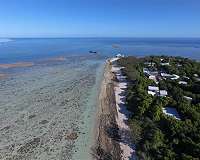
Microorganisms play a crucial role in forming beachrock, a type of rock that forms on the beach and protects low-lying reef islands from erosion, a new study involving University of Queensland research has revealed.
Professor Gordon Southam of UQ's School of Earth and Environmental Sciences said the findings threw new light on an area of coastal ecology that had been little studied, but could help protect islands such as in Australia's Great Barrier Reef.
"These results are of interest because beachrock could be used as a natural coastline stabilisation strategy on sand reef cays, and in turn, protect the unique habitats that reef islands support," Professor Southam said.
He said of all the coastal environments that would be influenced by sea-level rise and increased cyclone intensity, sandy beaches on low elevation coral reef cays were among the most vulnerable due to their susceptibility to erosion.
"Changes to reef islands will have negative implications for the existence of reef cay environments, which host vital sea turtle and bird rookery habitats," he said.
"Beachrock – consolidated carbonate beach sediment in the intertidal zone – forms naturally on many tropical beaches and reduces the erosion rates of these beaches when compared to unconsolidated sand.
"In spite of the critical role beachrock plays in stabilizing some reef cay shores, the mechanism of beach rock formation is still incompletely understood."
Co-author Professor Gregory Webb said in this investigation beachrock was synthesised in the laboratory using beach sand and beachrock samples from Heron Island on Australia's Great Barrier Reef.
The researchers conducted aquarium experiments in which natural beach rock formation conditions were simulated, with one experiment influenced by beachrock microbes and the other, lacking these bacteria.
The resulting materials were then analysed in the Australian synchrotron in Melbourne, and the analysis showed the fundamental role these bacteria play in initiating beachrock formation.
Professor Southam said the results provided a better understanding of the role of microorganisms in beachrock generation, and could guide future studies examining on site beachrock formation.
Acidified ocean water widespread along North American West Coast
A three-year survey of the California Current System along the West Coast of the United States found persistent, highly acidified water throughout this ecologically critical nearshore habitat, with "hotspots" of pH measurements as low as any oceanic surface waters in the world.
The researchers say that conditions will continue to worsen because the atmospheric carbon dioxide primarily to b … read more
