
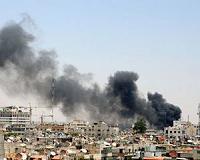
Heavy air strikes hammered opposition-held neighbourhoods of Syria's capital on Monday after regime forces pushed back a surprise assault that saw rebels try to fight their way into the city centre.
Rebels and allied jihadists, led by former Al-Qaeda affiliate Fateh al-Sham Front, launched an attack early Sunday on government positions in east Damascus, initially scoring gains.
But forces loyal to President Bashar al-Assad drove them back by nightfall and began a fierce bombing campaign on Monday morning, a monitor said.
"There have been intense air strikes since dawn on opposition-held positions in Jobar from which the offensive was launched," said Rami Abdel Rahman, head of the Syrian Observatory for Human Rights.
"The government and allied forces have retaken the initiative and are striking the groups that launched yesterday's assault," he added.
Abdel Rahman said it was unclear whether regime forces or their Russian allies were carrying out Monday's raids on Jobar.
Control of the district — which has been a battleground for more than two years and is the closest rebel position to the heart of Damascus — is divided between rebels and allied jihadists on one side, and government forces on the other.
Media activists in Jobar said at least 40 raids had targeted the neighbourhood since dawn, releasing footage of a cloud of black smoke enveloping heavily damaged buildings.
On Sunday, opposition fighters seized several buildings in Jobar before advancing into the neighbouring Abbasid Square area — the first time in two years the opposition had broken into that district.
The clashes killed at least 26 members of regime forces and 21 rebels and jihadists, Abdel Rahman said. He did not have an immediate toll for Monday morning's air strikes.
– Roads reopened –
Sniper fire and air strikes were heard across the city on Sunday as civilians cowered inside their homes and schools announced they would close because of the violence.
By Monday, the front line had been pushed back and AFP correspondents said activity in the typically bustling Abbasid Square was returning to normal levels.
Residents near the Abbasid Square bus station, which regime forces retook from rebels, stood on their balcony surveying the damage from the latest clashes.
Inside the station, several soldiers could be seen curled up under a blanket, taking a mid-morning nap after hours of heavy fighting.
Planes could still be heard above the city but many of the roads that had been sealed off by army troops the previous day were reopened.
According to the Observatory, government forces managed to recapture "70 percent of the territory" overrun by rebels in the capital and were attacking the remaining rebel-held positions between Jobar and the opposition's Qabun district to the north.
While the strategic objective of Sunday's offensive is unclear, observers say a possible goal was breaking the government's siege of Qabun.
"In their assault yesterday, rebels were able to open a road for several hours between Qabun and Jobar, but the area is now a front line and they can no longer cross between the two," Abdel Rahman said.
– New peace talks due –
State news agency SANA said Syrian government troops were targeting rebel bases around Jobar on Monday.
"The military operations north of Jobar targeted the areas from which the terrorists set out, and a large number of them were killed," it said.
The agency reported that opposition fighters on Sunday bombarded the Russian embassy compound in the capital's Mazraa neighbourhood but that there were no casualties.
The Islamist Faylaq al-Rahman rebel group and the Fateh al-Sham Front — known as Al-Nusra Front before it renounced its ties to Al-Qaeda — have a presence in Jobar.
Syria's conflict erupted in March 2011 with protests against Assad's rule but has evolved over the years into a complex civil war.
More than 320,000 people have been killed and millions more have been displaced by the conflict.
In recent months, the regime has sought to secure territory around the capital with renewed offensives on besieged rebel towns along with local "reconciliation" deals.
The war saw a turning point when Russia intervened in September 2015 in support of the regime, allowing pro-government forces to regain significant territory they had lost to the rebels.
The retaking of all of second city Aleppo late last year was a major blow to the opposition.
Repeated peace talks over the years have failed to bring about a political solution to the conflict. Another round of negotiations is due to begin in Geneva on Thursday.
Russia summoned Israeli ambassador over Syria strikes
Moscow (AFP) March 20, 2017 –
Russia's foreign ministry on Monday said it had summoned Israel's ambassador over air strikes close to Moscow's forces near the historic Syrian city of Palmyra.
Deputy foreign minister Mikhail Bogdanov told Interfax news agency that Ambassador Gary Koren was summoned on Friday and "asked about" the strikes.
The ministry "expressed concern" about the action taking place near Russian military locations, Bogdanov said.
Russia — which is conducting its own bombing campaign in Syria in support of President Bashar al-Assad — said earlier this month that more than 180 of its troops have started demining around Palmyra's ancient monuments.
Russia and Israel have set up a "hotline" aimed at avoiding air clashes over Syria and Bogdanov said Moscow "would like this channel to work more effectively" to ensure no "misunderstanding on who is doing what."
Israeli warplanes struck several targets on Friday, prompting retaliatory Syrian missile launches, in the most serious incident between the two countries since the war began six years ago.
Israel's military said it had been targeting weapons bound for Lebanon's Hezbollah movement, which backs Assad in Syria.
Syria's military said it had downed an Israeli plane and hit another as they were carrying out pre-dawn strikes near Palmyra, the famed desert city it recaptured from jihadists this month.
The Israeli military denied that any planes had been hit.
On Sunday, Israeli Defence Minister Avigdor Lieberman threatened to destroy Syria's air defence systems "without the slightest hesitation" if there was a similar incident.
Russia has deployed its own high-tech missile defence systems to Syria to protect its forces there.
Israel says it foiled Syrian ballistic missile threat
Jerusalem (AFP) March 20, 2017 –
A senior army officer said Monday that Israel had fired its Arrow missile at a Syrian rocket which posed a "ballistic threat" during clashes over the weekend.
Israeli warplanes struck several targets in Syria on Friday, drawing retaliatory missile fire, in the most serious incident between the two countries since the start of the Syrian war six years ago.
Prime Minister Benjamin Netanyahu said the air strikes targeted weapons bound for Lebanon's Shiite militant group Hezbollah, and that Israel would do the same again if necessary.
Syria's military launched anti-aircraft missiles at the attackers and said it had downed an Israeli plane and hit another as they carried out pre-dawn strikes near the desert city of Palmyra.
Israel denied any of its aircraft was hit.
Defence Minister Avigdor Lieberman on Sunday threatened to destroy Syrian air defence systems "without the slightest hesitation" if they fired on Israeli planes in future.
During the sortie, Israel threw its Arrow interceptor into the fray to take out what the officer said Monday was believed to have been a Russian-made SA 5 missile.
"It was a ballistic threat focused on the state of Israel," he said, speaking in English to foreign media on condition of anonymity.
"Our mission is to defend the state and the people of Israel," he added. "That was exactly the case last week."
Missile fragments fell in Jordan, which borders both Israel and Syria, without causing casualties.
But the Israeli officer said Monday that the Syrian missile, weighing "tonnes and carrying hundreds of kilos of explosives" had posed a threat that could not have been ignored.
"Try to imagine the meaning if this kind of threat would hit the cities and towns of Israel," he said.
Launching the Arrow, jointly developed by the United States and Israel, was "a correct and effective solution", he added.
Netanyahu: Syria raids targeted 'advanced' Hezbollah arms
Israeli warplanes struck several targets in Syria early Friday, prompting retaliatory missile launches, in the most serious incident between the two countries since the Syrian civil war began six years ago.
Israeli Prime Minister Benjamin Netanyahu said the strikes targeted weapons bound for Lebanon's Hezbollah, and that the Jewish State would do the same again if necessary.
Syria's mili … read more
