
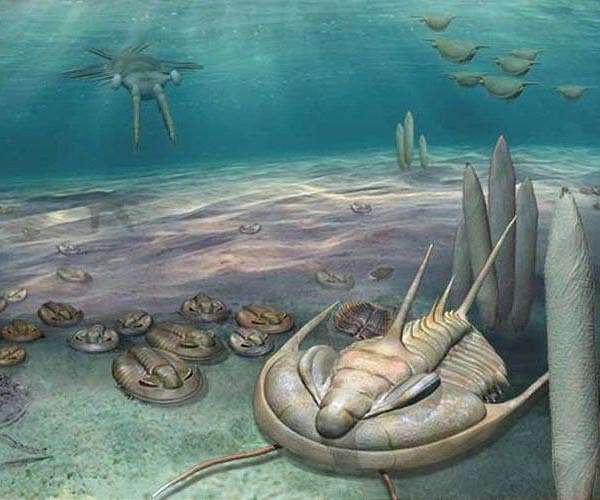
The mass of fossils found in Canada's Burgess Shale deposit are thought to exhibit the diversity of life that sprang forth during the Cambrian explosion 505 million years ago.
New research, however, suggests the fossils may not be what they seem — many of the fossils from the shale deposit could have been carried from far away by mudflows.
In a new study, published Wednesday in the journal Communications Earth and Environment, researchers determined fossils can remain well-preserved while being carried long distances by mudslides.
The research complicates the popular assumption that Cambrian fossils found concentrated in one place actually lived together in that place millions of years ago.
"This finding might surprise scientists or lead to them striking a more cautionary tone in how they interpret early marine ecosystems from half a billion years ago," study co-author Nic Minter said in a press release.
"It has been assumed that because the Burgess Shale fossils are so well preserved, they couldn't have been transported over large distances," said Minter, a paleontologist at the University of Portsmouth in Britain.
"This new research shows that the general type of flow responsible for the deposits in which they were buried does not cause further damage to deceased animals," Minter said. "This means the fossils found in individual layers of sediment, and assumed to represent animal communities, could actually have been living far apart in distance."
Using both field observations and lab experiments, scientists looked at how mudflows might have influenced the arrangement of fossils in British Columbia's Burgess Shale deposit, one of the most productive fossil sites in the world.
Through the decades, some 65,000 specimens, comprising more than 120 unique species, have been extracted from the deposit. Still more have yet to be unearthed.
Field surveys helped the researchers get a sense for how ancient mudflows might have moved across the region. Using their field observation, researchers set up flume tank tests to mimic the movement of mudflows in the lab.
The analysis showed some animals could have been moved great distances without their remains being materially compromised.
The Cambrian explosion began 500 million years ago and lasted just 13 million years. During the period, almost all major animal phyla emerged.
For decades, scientists have been working to unravel the mysteries of this extraordinary evolutionary outburst.
The latest research suggests that scientists investigating the mysteries of the Cambrian explosion have been working with potentially faulty information.
"We don't know over what kind of overall time frame these many flows happened, but we know each one produced an 'event bed' that we see today stacked up on top of one another," said lead author Orla Bath Enright, paleontologist at Portsmouth. "These flows could pick up animals from multiple places as they moved across the seafloor and then dropped them all together in one place."
"When we see multiple species accumulated together it can give the illusion we are seeing a single community," Bath Enright said. "But we argue that an individual 'event bed' could be the product of several communities of animals being picked up from multiple places by a mudflow and then deposited together to give what looks like a much more complicated single community of animals."
The authors of the new study suggest more work must be done to understand exactly how mudflows might have altered the arrangement of fossils within important Cambrian-era deposits.
