
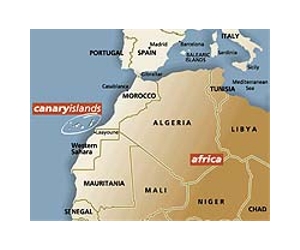
Spain's deficit-laden government approved Friday oil exploration by Repsol YPF SA off the Canary Islands despite opposition by the archipelago, which fears deterring tourists.
Initial oil exploration tests in 2001, which were halted by the courts in 2004, revealed several fields about 70 kilometres (40 miles) off the coast near the maritime border with Morocco, which has started drilling in the area.
Hydrocarbon production could reach 100,000 barrels a day, or 10 percent of the country's oil imports, making it the biggest single oil discovery in Spain, industry sources said.
Repsol, which owns 50 percent of the consortium exploring the area, hopes to begin drilling within two years, a company spokesman told AFP. The firm must first submit an environmental impact report to the government.
Its two partners in the venture are Australia's Woodside Petroleum Ltd., which holds 30 percent, and Germany's RWE AG, with the remaining 20 percent.
The regional government of the Canaries has already stated its opposition to the project, fearing damage to the tourism industry. The archipelago is Spain's second most popular tourism destination after Catalonia.
Paulino Rivero, head of the Canary Islands' government, said the archipelago would use all legal means at its disposal to stop the oil exploration.
"An interesting battle has begun," he told a televised news conference in Puerto del Rosario on the island of Fuerteventura.
"The central government treats us as if we are a colony lost in the Atlantic. This decision serves just one purpose: to benefit a private company," added Rivero who belongs to the Coalicion Canaria, a Canarian nationalist party which pushes for greater autonomy for the islands.
Greenpeace said it will stage protests against the oil exploration in various cities in the archipelago on March 24.
It said the decision to allow oil exploration off the Canary Islands was "irresponsible" because it exposes the citizens and environment of the region to serious risk."
"Deepwater operations are inherently dangerous and pose enormous risks of spills, fires and pollution as demonstrated by the collapse of the BP platform in the Gulf of Mexico less than two years ago," the group added in a statement.
Spain, which now produces only about 2,000 barrels a day, is almost entirely dependent on oil imports. Although a fifth of its energy comes from wind, rising oil prices have raised pressure on the economy, which is expected to slide into recession this quarter.
According to calculations by the previous Socialist government, which lost power in November 2011 elections, each 10-euro increase in the oil price adds six billion euros ($7.9 billion) to the country's energy bill.
The new conservative Popular Party government, which took power in December, has promised to slash the public deficit from 8.5 percent of gross domestic product to 5.3 percent in 2012 and 3.0 percent in 2013.
