
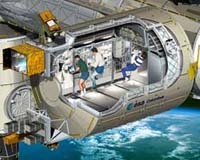
Astronauts will add Friday a storage unit on top of Japan's new laboratory at the International Space Station, making the outpost's biggest facility even roomier.
The storage unit was brought to the station by a US space shuttle in March while the bus-sized Kibo lab was delivered and installed this week by the Discovery mission.
Japanese astronaut Akihiko Hoshide and US counterpart Garrett Reisman were to unlock the storage module from its temporary location on the station by removing jumper cables and depressurizing a passageway.
Mission specialist Karen Nyberg and station flight engineer Greg Chamitoff will then operate the station's Canadian robotic arm to move the unit to its new home atop the cylindrical Kibo lab.
The crew will also activate the Japanese facility's robotic arm.
Mission specialists Mike Fossum and Ron Garan conducted a seven-hour spacewalk to attach front and rear television cameras outside the science lab and make preparations for the storage unit's installation.
Kibo — which means "Hope" in Japanese — represents Japan's and Asia's first major contribution to the orbiting international station, which already has modules from the United States, Russia and the European Space Agency.
The lab's third main component, an exterior "balcony" to hold experiments exposed to the microgravity of space, will be delivered to the station during a shuttle mission next year.
When completed, Kibo will allow the station, which usually has three crew members, to double its occupancy to six people.
The lab will allow astronauts to carry out experiments in medicine, biology and biotechnology, material production and communications, both in a pressurized environment and completely exposed to space.
