
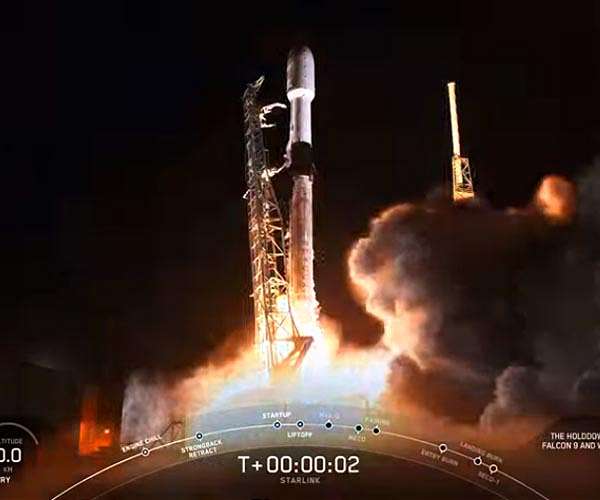
Elon Musk's SpaceX launched 53 Starlink satellites from Florida early Saturday morning after a short delay.
The company was scheduled to launch the spacecraft on a Falcon 9 rocket at 11:23 p.m. EDT from Complex 40 at Cape Canaveral Space Force Station.
However, the launch was pushed back until to a new target launch of 12:42 a.m. "due to unfavorable weather," the company said in a statement.
Liftoff time was instantaneous, meaning any problems could prompt a delay of about 24 hours to Saturday night.
The launch comes as Musk and SpaceX have made multiple deliveries of Starlink terminals to the Ukrainian government for use as it defends against a Russian military invasion.
Mykhailo Fedorov, vice president of Ukraine, tweeted on Friday that his government had received another of several shipments of the terminals, which allow access to high-speed internet via more than 2,000 Starlink satellites in orbit.
"A new batch of Starlink stations! While Russia is blocking access to the Internet, Ukraine is becoming more open to the entire world. Ukraine is the truth. The truth always wins. Thank you, @elonmusk, the Government of Poland, and Orlen," Fedorov tweeted.
Orlen apparently refers to a Polish gas and oil company that may have been involved in getting the terminals to Ukraine.
Weather poses a 30% chance of violating launch conditions, according to a U.S. Space Force forecast.
"Showers will diminish as they reach the coast," forecasters said, adding that cumulus clouds posed the biggest potential issue for the launch.
The first-stage booster for the rocket will be flying for the 12th time, having already boosted eight Starlink missions, the SpaceX Demo-1 uncrewed test flight to the International Space Station, the launch of Canadian RADARSAT spacecraft and the Sirius SXM-7 satellite.
SpaceX succesfully recovered the booster after launch by landing it robotically on an uncrewed drone ship in the Atlantic Ocean.
