
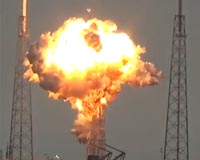
According to a statement released October 28, SpaceX has made progress in determining the cause of last month's accident on the Falcon 9 rocket's launch pad and expects to resume flights before the end of this year.
After the incident, in which the entire Falcon 9 rocket and its AMOS-6 satellite payload was lost, a group of experts including professionals from the Federal Aviation Administration, NASA and the US Air Force, has been thoroughly investigating possible causes.
SpaceX stated shortly after the explosion that it happened during fueling of the launch vehicle before a routine static fire test rather than during the test itself, and that the "anomaly" was likely caused by a breach in the rocket's cryogenic helium system.
In the latest statement, the company said that the investigation has zoomed in on a specific pressurized helium container located in the second-stage oxygen tank.
"Attention has continued to narrow to one of the three composite overwrapped pressure vessels (COPVs) inside the LOX tank," the release read.
In recent testing at the company's facilities in Texas, experts have managed to recreate the exact conditions that caused the COPV to fail.
According to SpaceX, the failure can occur "entirely through helium-loading conditions" mainly affected by the helium's temperature and pressure.
The company intends to continue to probe for the "exact root cause" of the eruption and to develop improved helium loading conditions to make sure there's no repeat of the failure.
But given that the incident likely was caused by helium handling issues rather than a design issue with the rocket itself, SpaceX expects to return to flight operations before the end of 2016.
