
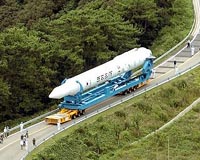
South Korea's first space rocket has been moved to its launch pad from the assembly complex in preparation for the historic launch scheduled for this week, the state-run aerospace institute said Sunday.
Korea Aerospace Research Institute (KARI), responsible for the launch, said the Korea Space Launch Vehicle-1 (KSLV-1), also called Naro-1, reached the launch pad earlier in the day with engineers to erect the rocket by 3:50 p.m.
It said all mechanical and electrical cables will be connected by 9:00 p.m. with engineers to conduct a thorough check-up to see if the rocket can be fired.
KARI said that if there are no last minute problems with the weather or launch systems, the country's first satellite-carrying rocket will blast off on Tuesday around 5:00 p.m.
South Korea has already notified both the International Civil Aviation Organization and the International Maritime Organization that the Naro-1 will blast off Tuesday, although it is reserving a "launch window" up till Wednesday in case of unforeseen delays.
The blastoff date was originally scheduled for July 30 but was pushed back to Aug. 11 after Russia said it could not conduct the critical fire test on time.
It was again postponed to Aug. 19 but the countdown was stopped on that date with less than eight minutes remaining before ignition, after a software glitch detected a problem in the high pressure tank that can affect valves in the first-stage rocket. Seoul has since repaired the problem responsible for stopping the countdown.
South Korea with no experience in the launching of a space rocket capable of carrying a satellite into orbit, has been working with Russia's Khrunichev State Research and Production Space Center to make the rocket.
The rocket, developed from 2002 at a cost of 502.5 billion won (US$402.3 million), stands 33 meters tall, has a diameter of 2.9 meters, weighs 140 tons and can generate 170 tons of thrust. The first stage liquid-fueled rocket was made in Russia, while the smaller second stage rocket powered by solid fuel and the satellite were made in the country.
Source: Yonhap
Source: Xinhua News Agency
Share This Article With Planet Earth
