
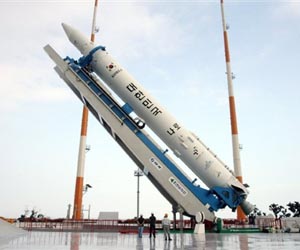
South Korea is carrying out a final launch rehearsal for its space rocket scheduled to be sent into orbit later this week, the government said Monday.
The Ministry of Education, Science and Technology said a complete systems check on the Korea Space Launch Vehicle-1 (KSLV-1) is underway at the Naro Space Center, 485 kilometers south of Seoul. It will effectively mimic an actual launch. The tests involve the sending of electrical signals to the rocket to see if controls are responding in a normal manner.
The KSLV-1, also called Naro-1, was moved from the rocket assembly building at the space center to the launch pad earlier in the day in preparation for Wednesday's launch.
"Systems checks on both the first and second stage rockets are to be completed by 5:30 p.m. with complete analysis to be carried out afterwards to see if the rocket and the scientific satellite are ready for blastoff," said Yoo Guk-hee, head of the ministry's space development division said.
He said that depending on the analysis, the rocket management committee headed by Vice Science Minister Kim Jung-hyun will make the final decision to order the launch of the rocket.
"The final decision will be made after consultation with Russian technicians, weather conditions around the launch pad off the country's southern coast, and possibility of the rocket striking another object in space," Yoo said. He said the exact time of the launch will be announced at 1:30 p.m. on Wednesday.
The 33-meter-long Naro-1 is South Korea's second locally assembled space rocket. The first, which lifted off on August 25, failed to place a 100 kilogram scientific satellite into orbit due to a malfunction in the fairing assembly.
South Korea, with no experience in building space rockets, sought Russian help in 2002 for the Naro-1 project. The country has since spent 502.5 billion won (US$407.2 million) on the rocket-building effort and will develop a larger rocket by 2020 that can send an unmanned probe to the Moon.
Source: Yonhap News Agency
Share This Article With Planet Earth
