
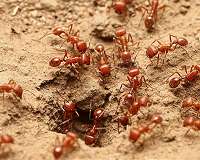
Not all ants serve a single queen. Researchers have discovered colonies of tropical fire ants, insects native to Florida and coastal Georgia, living under the rule of multiple queens.
Scientists discovered the multi-queen colonies situated next to single-queen colonies.
"The coexistence of two dramatically different social structures fascinated me," researcher Kip Lacy said in a news release. "I had to know more."
Now a graduate fellow at Rockefeller University, Lacy made the discovery while earning his master's degree in entomology at the University of Georgia.
During their survey of fire ant colonies, Lacy and his colleagues at the U.S. Department of Agriculture Agricultural Research Service in Gainesville, Florida, found single-queen colonies just a few feet away from colonies boasting a matriarchy of 13 queens.
"They can exist right next to each other, but their social structure remains intact," Lacy said.
One of Lacy's colleagues, Ken Ross, a researcher at the University of Tennessee, previously identified multi-queen or "polygyne" colonies while studying Georgia's invasive red imported fire ants. He determined the multi-queen behavior was triggered by a "social chromosome," a genetic mutation that causes "polygyne sydrome."
Ross also found members of polygyne colonies were smaller in size and demonstrated lower levels of aggression toward unfamiliar ants. But in both types of red imported fire ant colonies, female offspring — whether queens or workers — are produced sexually.
Conversely, queens in polygyne colonies of tropical fire ants reproduce asexually. When Lacy and his colleagues conducted genetic analysis, they found all reproductive queens and daughter queens within polygyne colonies boasted the exact same genetic makeup.
Worker ants inside polygyne colonies featured significant genetic diversity, proving they are not clones.
"That was a surprise because we also found that the male ants in these colonies seem to be sterile," Lacy said.
Researchers determined queens from multi-queen colonies mate with males from single-queen colonies to maintain the colony's genetic diversity.
"The males get nothing out of it because their sperm goes to produce workers that are sterile," Ross said. "Those males' genetic lines end there."
Lacy, Ross and the rest of the team dubbed the behavior "sperm parasitism." They described their discovery this month in the journal Current Biology.
Death in China zoo puts rarest turtle on cusp of oblivion
Shanghai (AFP) April 15, 2019 –
The world's rarest turtle has moved a step closer to extinction after a female specimen died in a Chinese zoo, leaving behind just three known members of the species.
The Yangtze giant softshell turtle, believed to be above 90 years of age, died in Suzhou Zoo on Saturday, according to the Suzhou Daily.
Its death came a day after zoo officials made a last-ditch effort at artificial insemination using semen from a male companion estimated to be more than 100 years old, according to the Suzhou Daily.
The zoo tried unsuccessfully for several years to get the pair to mate and reproduce naturally. It will now conduct an autopsy to determine what caused the animal's death, the newspaper reported.
Conservations say there are now only two other known members of the species left, both living in the wild in Vietnam and of unknown gender.
The Yangtze giant softshell turtle is the largest freshwater turtle in the world, growing to 100 cm (39 inches) long and weighing up to 100kg (220 pounds).
The turtle's main habitat was the Yangtze River and other inland China waterways.
But aquatic life in China's rivers has suffered severely from centuries of hunting and, more recently, decades of pollution, shipping traffic and ecological disruption wrought by hydroelectric dams.
