
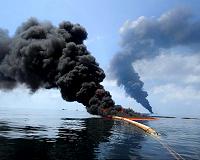
Operations in the Gulf of Mexico are shut down as a result of a recent fire on a platform and there's no immediate indication of a restart, Hess Corp. said.
Hess is working alongside the Dutch supermajor, which said last week that two people were injured during a fire on board the Enchilada platform on the Garden Banks reservoir in the Gulf of Mexico.
There were no signs that oil was on the water at the time of the incident. A spill-response vessel was mobilized to the area as a precaution. The fields in question are about 100 miles away from the nearest shoreline.
Shell said two of its platforms were closed down, as was a 30-inch natural gas pipeline. Hess said Monday it was told that a repair plan was being developed, but closed down production from three of its fields as a result.
"Though the structure is visibly sound, crews will continue to determine the integrity of the platform and formulate a plan for damage repair," Shell said.
Hess said its share of production was 30,000 barrels of oil equivalent per day, adding it was working with Shell to get a better sense of when operations could resume.
Shell said Sunday it was winding down emergency response operations, but was working closely with the U.S. Bureau of Safety and Environmental Enforcement to figure out what caused the incident.
The BSEE was set up in response to failures with the former federal Minerals Management Service in the Deepwater Horizon oil spill in the Gulf of Mexico in 2010.
A measure under consideration in the U.S. House of Representatives to expand offshore drilling opportunities would recombine the Bureau of Ocean Energy Management with the BSEE. Former BOEM Director Michael Bromwich told lawmakers that proposal was "a profoundly bad idea."
The U.S. waters of the Gulf of Mexico account for about 17 percent of total national oil production and 5 percent of the dry natural gas production per day.
Traces of major palm oil spill still linger in Hong Kong
Traces of palm oil are still fouling a remote part of Hong Kong's shoreline three months after a major spill caused by a ship collision, environmentalists say.
One thousand tonnes of the solidified oil leaked from a cargo ship which collided with another vessel near the Pearl River estuary in early August.
More than 200 tonnes reached Hong Kong's shores, forcing beaches to close and kill … read more
