
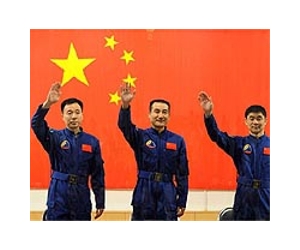
Yet another media report from China has confirmed the basics of their latest group of astronauts. Five men and two women are being trained for Shenzhou missions. In keeping with China's typical policy of secrecy, we don't know their names or faces yet, but analysts are making educated guesses from previously disclosed lists of candidates.
All the astronauts are experienced pilots from China's Air Force. So far, China has not taken the step of diversifying its astronaut corps with scientists or medical doctors. It's possible that "mission specialist" astronauts will be recruited before China launches its large space station around 2020.
While we try to find out who these people are, other questions must also be asked. How will the entry of these new astronauts affect the overall balance of China's astronaut corps?
Previous Chinese reportage has hinted that some of China's first batch of astronauts would be expected to retire in the near future. Chinese media statements claim that the new recruits will replace "some of the batch" that was first recruited in 1998. But we still don't know how many will retire, or who. Some of the original group may be retired without flying a single space mission.
How many active astronauts does China expect to have ready at any given moment? Again, this is unclear.
China may end up using experienced astronauts from its first batch as commanders on Shenzhou 9 and 10, which are expected to launch in 2012.
These missions will dock with the Tiangong 1 space laboratory, which will be launched in 2011. Each mission is expected to fly three astronauts, and there could easily be a woman on Shenzhou 9. The third seat could be taken by a previously unflown astronaut from the first batch.
This scenario sounds plausible, but there is no real evidence to support it. Crew strategies are also opaque at the present.
It will be interesting to see if the new batch is trained differently from the first. By now, trainers and the astronauts themselves will have a lot more experience with spaceflight and mission planning. The next astronauts will probably find their training moves faster and more smoothly than the first batch.
Share This Article With Planet Earth
