
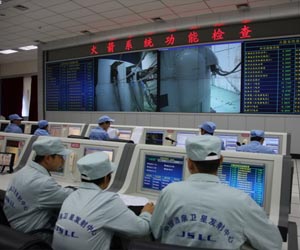
The space module Tiangong-1 and spacecraft Shenzhou-8 will conduct rendezvous and docking experiments twice as scheduled and then Shenzhou-8 will return to the earth while Tiangong-1 will continue to move in its orbit, according to the Beijing Aerospace Control Center. The second rendezvous and docking is scheduled around Nov. 14.
Experts said the second rendezvous and docking will test the reusability of rendezvous and docking equipment as well as their performances in different environments.
The second rendezvous and docking will be conducted in a bright area, posing challenges to optical sensors used for the docking of the spacecraft in three aspects.
First, the strong interference of miscellaneous lights will have a considerable effect on the accuracy of sensors of measuring equipment as well as the reliability of relative navigation and increase the risks in conducting the rendezvous and docking experiment.
Second, the combined unit will carry out a series of mechanical motions during the first separation control, and therefore whether the unit will separate precisely according to the plan is very crucial for the second dock.
Third, while the combined unit is separating, the two spacecraft, under the action of the mechanical force, will be departing from each other gradually too.
Due to the imbalance of the acting force, relatively large stance fluctuation may appear and affect the normal evacuation.
How the relative stances of the two spacecraft should be controlled and the relative navigation should be maintained is also a key point for the second docking.
