
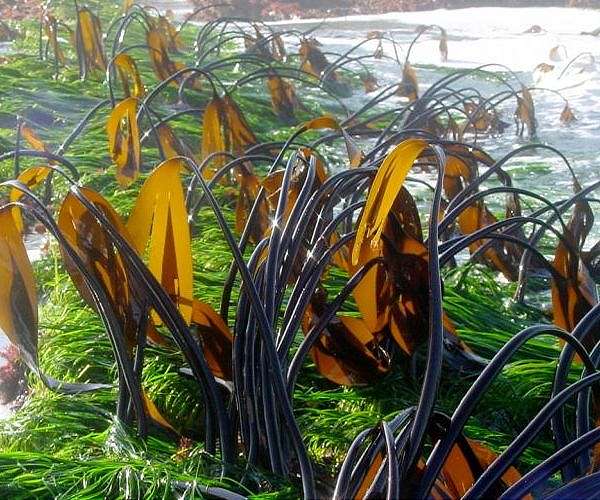
Britain's coastal waters have lost a lot more seagrass than has been previously estimated.
According to a new study, published Thursday in the journal Frontiers in Plant Science, seagrasses along Britain's coast have declined by 44 percent since 1936. More than a third of the losses have occurred during the last 40 years.
For the study, scientists compiled field data on seagrass abundance from a variety of sources. The diverse dataset helped researchers map the current and historic extent of seagrass.
Using differences in seagrass extent plotted by multiple sources, scientists were able to estimate and tally losses over the last 84 years.
Britain's coastal waters are home to two seagrass species, Zostera marina and Zostera noltii. Like coral reefs and mangroves, seagrasses help control flooding and prevent storm damages. They're also extremely efficient at storing carbon.
Seagrass meadows are also a vital habitat for sea bass, sea horses and a rich diversity of marine species.
"Raising the profile of this undervalued ecosystem will undoubtedly support its protection and rejuvenation," lead study author Alix Green, postdoctoral researcher with University College London, said in a news release.
Previous surveys have estimated Earth's global seagrass extent as declined by roughly 29 percent over the last century, but in many parts of the world the picture of regional seagrass extent is unclear.
When comparing different sources for seagrass extent across British waters, scientists separated pre-1998 and post-1998 data — "historical" and "contemporary" data. Researchers also rated the accuracy of each source as high, medium or low certainty.
"Our paper establishes the best estimate of current seagrass extent in [Britain], confirming at least 8,493 hectares, and documents a loss of at least 39 percent of aerial cover in the last 30 years," Green said. "Historically, we show that this loss could be as much as 92%, and that these meadows could have stored 11.4 million tons of carbon and supported approximately 400 million fish."
Researchers suggest their findings did reveal some isolated evidence of seagrass recovery in areas that were previously degraded but have since benefited from environmental protections.
The findings suggest much-needed protections for vulnerable marine ecosystems, including coastal seagrass meadows, can work, the researchers said.
"Our systematic documentation of the loss of seagrass needs to be seen as a positive moment to start the rejuvenation of our coastal seas," said study co-author Richard Unsworth.
"Now is the time to create financial mechanisms that reduce the flow of nutrients into our coastal seas, and offsetting mechanisms to allow a pathway of carbon finance into the conservation and restoration of these systems. By reversing this loss, we can improve our fisheries, reduce coastal erosion and fight climate change," said Unsworth, a lecturer at Swansea University and director of the marine conservation charity Project Seagrass.
