
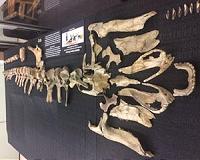
Scientists in Japan have discovered the island nation's largest complete dinosaur skeleton. The record-breaking, 72-million-year-old fossils were unearthed on Japan's northern island of Hokkaido.
The bones belong to a duck-billed dinosaur specimen. Paleontologists from Hokkaido University and Hobetsu Museum in Mukawa have been excavating the skeleton since 2013.
Duck-billed dinosaur species, or hadrosaurs, have been unearthed in North America, South America, Eurasia and Antarctica. The herbivores thrived during the Late Cretaceous Period, between 100 million and 66 million years ago.
However, the latest discovery marks just the third time a Hadrosaurid has been recovered from marine deposits. It's rare for a complete skeleton to be found in marine strata.
The species of the newly discovered dinosaur is unknown, but scientists dubbed the dino "Mukawaryu," Japanese for Mukawa dragon.
A complete skeleton is any fossil skeleton with more than 50 percent of the specimen's bones.
"We first discovered a part of the fossilized Mukawaryu skeleton in 2013, and after a series of excavations, we believe we have cleaned more than half of the bones the dinosaur had, making it clear that it is a complete skeleton," lead researcher Yoshitsugu Kobayashi said in a news release.
The Hadrosaurid family tree is divided into two distinct groups. Species with a crest belong to Lambeosaurinae, while uncrested species belong to Hadrosaurinae.
"Although Mukawaryu has some characteristics of both groups, our preliminary analysis indicated it might belong to the Hadrosaurinae," Kobayashi said. "Further cleaning of the fossils and detailed research should make it clearer which group the Mukawaryu skeleton belongs to."
How methane-making microbes kept the early Earth warm
For much of its first two billion years, Earth was a very different place: oxygen was scarce, microbial life ruled, and the sun was significantly dimmer than it is today. Yet the rock record shows that vast seas covered much of the early Earth under the faint young sun.
Scientists have long debated what kept those seas from freezing. A popular theory is that potent gases such as methane – … read more
