
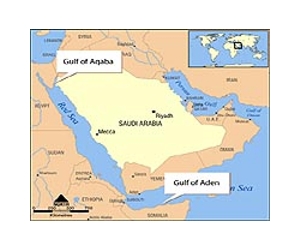
The recent roundup of more than 100 suspected al-Qaida operatives in Saudi Arabia underlined the severity of the terrorist threat facing the kingdom from neighboring Yemen.
It also emphasized the key role in the emerging campaign played by Said al-Shihri, who, as deputy leader of al-Qaida in the Arabian Peninsula, seems to have charge of all operations against the Saudis.
The Saudi Interior Ministry announced Friday that 113 people had been arrested over the previous five months. Maj. Gen. Mansour al-Turki, the ministry spokesman, said the suspects, who included 47 Saudis and 51 Yemenis, had been plotting suicide attacks against Saudi oil and security installations.
They allegedly received orders through coded e-mail from an al-Qaida commander known as Abu Hajer. The Saudis say that is a nom de guerre of al-Shihri, a Saudi who was captured by U.S forces in Afghanistan in December 2001.
He spent six years in the U.S. detention camp at Guantanamo Bay, Cuba, before being released in December 2007 with other Saudis and repatriated. He attended a government-run rehabilitation program and after his release in January 2009 he fled to Yemen, Osama bin Laden's ancestral home.
There he and other al-Qaida veterans merged the Saudi and Yemeni jihadist offshoots into al-Qaida of the Arabian Peninsula and vowed to bring down the monarchy in Saudi Arabia to establish an Islamic caliphate.
Al-Shihri and other seasoned jihadists, like AQAP's leader, Nasser Abdul Karim al-Wuhayshi, a Yemeni who is a former personal assistant to bin Laden, have built a new jihadist network that has thrived amid the political turbulence pummeling Yemen.
Some of the veterans gathered in Yemen were survivors of al-Qaida's organization in Saudi Arabia that was crushed by security forces in 2007 after a four-year campaign in which scores of people perished.
Khamran Bokhari, a counter-terrorism expert with the U.S. global security consultancy Stratfor, notes that the Saudis were able to "mobilize the tribal, religious, security and commercial spheres of the country against Islamist rebels" in 2003-07.
But in Yemen, where central government is weak and doesn't dominate the religious establishment as the Saudi monarchy does and tribal affiliations more fragmented, this isn't possible.
"The secret to the Saudis' success was turning the rebels' strongest weapon, religion, back against them," Bokhari observed in a recent analysis.
"This was possible because the state enjoyed a monopoly over religious discourse thanks to the vast religious establishment that Riyadh had cultivated over the years
"The huge differences in economic conditions, religious hierarchy and tribal structures between Saudi Arabia and Yemen accordingly will make it difficult for Riyadh to reproduce in its southern neighbor the successful results it has enjoyed at home," Bokhari concluded.
AQAP's attempt to assassinate Prince Mohammed bin Nayef, Saudi Arabia's deputy interior minister, last August underlined the boldness of the Yemeni organization's operational capabilities and its innovative planning.
The network was able in infiltrate a suicide bomber into the heavily guarded Jeddah palace of Prince Mohammed, who headed the security forces that crushed the jihadists in Saudi Arabia and got within an ace of killing him.
The Jamestown Foundation, a Washington think tank that monitors global terrorism, noted this month, "Easy targeting of Saudi Arabia is considered to be one of the benefits of al-Qaida's creation of a safe haven in Yemen."
AQAP's ability to recruit and infiltrate 113 operatives — and possibly others not yet blown — "and distribute them in different cells indicates that AQAP represents a legitimate threat to Saudi national security," Jamestown said.
Turki noted that the people rounded up recently were aged 18-25, much younger than the suspects the Saudis say they have captured since 2003.
Jamestown said that indicates "a new generation of Saudi al-Qaida members This suggests that al-Qaida has succeeded in developing new methods to attract youngsters despite Saudi efforts to counter al-Qaida on the ideological level."
Al-Shihri's leadership role is expected to expand. He appears to control all operations inside Saudi Arabia, one of the most important targets for al-Qaida because of its dominant role in the Arab world and as the guardian of Islam's holiest shrines in Mecca and Medina.
Share This Article With Planet Earth
