
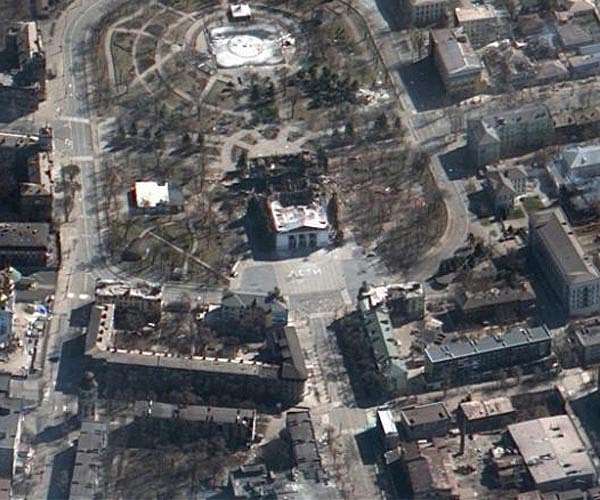
A theatre sheltering civilians destroyed in March in the besieged Ukrainian city of Mariupol was likely hit by a Russian airstrike in a war crime, Amnesty International said in a report published Thursday.
"Until now, we were speaking about an alleged war crime. Now we can clearly say it was one, committed by the Russian armed forces," Oksana Pokalchuk, head of Amnesty's Ukraine branch, told AFP.
"These explosions were caused by something really big: two 500-kilogramme (1,100-pound) bombs" dropped from a plane, she added, dismissing Russian claims that the theatre was hit in a false-flag attack by the city's Ukrainian defenders.
Nevertheless, the group also found that the death toll may have been smaller than initially believed.
Amnesty spoke to dozens of survivors and witnesses about the March 16 strike and also gathered evidence such as photos, video and satellite images of the scene and documents including plans of the destroyed theatre.
As a designated shelter site after Russia's invasion began on February 24, thousands gathered at the theatre on different days in early March, hoping to join evacuation convoys.
Volunteers were distributing food, water and essential items like blankets, as well as providing medical care.
"In Mariupol, there were so many military targets. They clearly chose the civilian one," Pokalchuk said, adding that this would have been clear to Russian commanders from drone and satellite imagery.
Several departures — unofficial or through negotiated humanitarian corridors — in the days leading up to the blast drained the numbers holed up in the building.
But "a man who volunteered in the field kitchen said that they were still cooking for 800 people on the day of the attack," Amnesty wrote.
Analysis of the impact on the theatre suggested the detonation of 400-800 kg of explosives.
Amnesty said that most likely came from two 500-kg bombs, based on evidence including debris survivors described from the scene and details of the pattern of Russian operations in the region at the time.
Meanwhile, the group gathered no testimony backing up the Russian claim of a false-flag attack.
Based on eyewitness statements and public death reports, "Amnesty International believes that at least a dozen people died in the attack, but also that it is likely that many additional fatalities remain unreported," the group added.
Mariupol city authorities had provided an initial estimate of around 300 deaths, while an Associated Press investigation suggested the toll could be up to 600.
"It is good news that fewer people were killed. But it doesn't change anything. It is still clearly a war crime," Pokalchuk said.
NATO leaders denounce Russia's 'appalling cruelty' in Ukraine
Madrid (AFP) June 29, 2022 –
NATO leaders on Wednesday decried Russia's brutal aggression in Ukraine and said Moscow now posed a "direct threat" to the Western alliance.
"Russia's appalling cruelty has caused immense human suffering and massive displacements, disproportionately affecting women and children", a declaration from a summit in Madrid said.
NATO leaders have funnelled billions of dollars of arms to Ukraine and faced appeals from President Volodymyr Zelensky for more artillery.
Alliance chief Jens Stoltenberg announced a new joint package of non-lethal support including secure communications equipment and anti-drone systems.
The assistance will also extend to training Ukrainian forces to pivot to more modern Western weapons over the longer term.
"Ukraine can count on us for as long as it takes," Stoltenberg said.
The war in Ukraine has shaken the 30-nation alliance and forced it into the biggest overhaul of its defences since the end of the Cold War.
The summit agreed a new guiding blueprint for NATO that said Russia "is the most significant and direct threat to Allies' security and to peace and stability in the Euro-Atlantic area".
"We cannot discount the possibility of an attack against allies' sovereignty and territorial integrity," the document, updated for the first time since 2010, said.
In a bid to counter the menace from Russia, leaders agreed to bolster their forces in eastern Europe.
"Allies have committed to deploy additional robust in-place combat-ready forces on our eastern flank," the summit statement said.
