
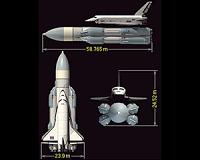
Russia's Military Academy of Strategic Missile Forces accomplished the task of developing a power plant for a plane that allows it to alternate between the airbreathing regime during a flight in the atmosphere and rocket propulsion regime during a flight in space, according to an official.
Russia's Military Academy of Strategic Missile Forces said Monday its had developed an engine for a prospective dual-purpose spaceplane.
"We have accomplished the task of developing a power plant for a plane that allows it to alternate between the airbreathing regime during a flight in the atmosphere and rocket propulsion regime during a flight in space," an academy official told reporters at the Innovations Day of the Russian Defense Ministry-2015 exhibition.
The official stressed that a combined airbreathing-rocket engine with a pulse detonation combustion chamber has a very high thermodynamic efficiency, which would allow to reduce significantly the cost of orbital cargo delivery.
According to the academy's preliminary estimation, the production cost of each engine is estimated to be about 90 million rubles ($1.4 million), while the liquid-propellant engines for one-stage rockets cost about 120-140 million.
If built, the prospective spaceplane would become a successor of the Soviet Buran (Snow Storm) reusable space shuttle, that carried out its first and only orbital launch in 1988 before the program was canceled following the dissolution of the Soviet Union.
