
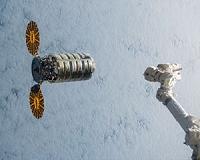
At 5:04 a.m., Expedition 53 Flight Engineers Paolo Nespoli of ESA (European Space Agency) and Randy Bresnik of NASA successfully captured Orbital ATK's Cygnus cargo spacecraft using the International Space Station's robotic arm.
The Orbital ATK Cygnus cargo ship was then position and bolted into place on the International Space Station's Earth-facing port of the Unity module at 7:15 a.m. EST.
The spacecraft will spend about three weeks attached to the space station before departing in early December. After it leaves the station, the uncrewed spacecraft will deploy several CubeSats before its fiery re-entry into Earth's atmosphere as it disposes of several tons of trash.
The spacecraft's arrival brings close to 7,400 pounds of research and supplies to support Expedition 53 and 54. Highlights include:
+ The coli AntiMicrobial Satellite (EcAMSat) mission, which will investigate the effect of microgravity on the antibiotic resistance of E. coli, a bacterial pathogen responsible for urinary tract infection in humans and animals. Antibiotic resistance could pose a danger to astronauts, especially since microgravity has been shown to weaken human immune response.
The experiment will expose two strains of E. coli to three different doses of antibiotics; one of these strains is deficient in the gene responsible for the increased antibiotic resistance in microgravity.
Results from this investigation could help determine appropriate antibiotic dosages to protect astronaut health during long-duration missions and help us understand how antibiotic effectiveness may be increased in microgravity, as well as on Earth.
+ The Optical Communications and Sensor Demonstration (OCSD) project, which will study high-speed optical transmission of data and small spacecraft proximity operations. It will test functionality of laser-based communications using CubeSats that provide a compact version of the technology. Results from OCSD could lead to significantly enhanced communication speeds between space and Earth and a better understanding of laser communication between small satellites in low-Earth orbit.
+ The Biological Nitrogen Fixation in Microgravity via Rhizobium-Legume Symbiosis (Biological Nitrogen Fixation) investigation, which will examine how low-gravity conditions affect the nitrogen fixation process of Microclover, a resilient and drought tolerant legume.
The nitrogen fixation process, a process by which nitrogen in the atmosphere is converted into a usable form for living organisms, is a crucial element of any ecosystem necessary for most types of plant growth.
This investigation could provide information on the space viability of the legume's ability to use and recycle nutrients and give researchers a better understanding of this plant's potential uses on Earth.
+ The Integrated Solar Array and Reflectarray Antenna (ISARA), a hybrid solar power panel and communication solar antenna that can send and receive messages, will test the use of this technology in CubeSat-based environmental monitoring. ISARA may provide a solution for sending and receiving information to and from faraway destinations, both on Earth and in space.
NanoRacks launches Full External Cygnus Deployer on OA-8 to ISS
Early this morning, the Orbital ATK CRS-8 (OA-8) launch carried another historic NanoRacks mission to the International Space Station (ISS). With a completely full NanoRacks External Cygnus Deployer (ENRCSD), a virtual reality camera, and educational research, this mission marks over 600 NanoRacks payloads delivered to the ISS since 2009.
This mission is enabling a unique virtual reality o … read more
