
A stroke happens when blood flow is cut off from an area of the brain, and the cells begin to die. This means that the person suffering from a stroke loses abilities that are controlled by that part of the brain, such as walking or talking.
It is one of the leading causes of disability, and the most common affect that people are left with is weakness in one side of the body.
There is little known about what can help or hinder patients that have hand motor function, so researchers have used an upper limb robotic exoskeleton called the CAREX to compare motor learning in people who have had a stroke and those who have not. They also looked at the effectiveness of the device at different stages of recovery.
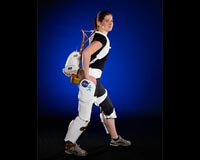
The CAREX was developed by Sunil K. Agrawal from Columbia University's The Fu Foundation School of Engineering and Applied Science. It is new, lightweight exoskeleton that is currently being used with patients at the Motor Recovery Research lab at NY Langone Medical Center's Rusk Rehabilitation.
The Study
"Rehabilitation for individuals with stroke is time and labor intensive," explains Lead Investigator in the study, Syed Zain Ali; a second-year medical student at NYIT College of Osteopathic Medicine.
"Hence rehabilitation technology is being developed to facilitate more therapy with limited human resources, with the help of robots for rehabilitation. However, the use of robots for rehabilitation may not be a one-size-fits all approach.
"We need to understand how to optimize training for individual patients. This study was initiated to understand which facets of robotic training benefit patients at different stages of recovery, so that the right training approach can be chosen for each patient."
The exoskeleton consists of three lightweight cuffs on the shoulder, on the arm and on the forearm, all attached to motor-controlled cables. The study evaluated 14 individuals who had had strokes and subsequent weakness in the right hand side of their body. They were compared to seven people who had not had a stroke, while they (all participants) completed drawing exercise.
The participants were seated, with their torsos secured with a four point seatbelt, and asked to draw three sets of 20 circles. They were required to follow a predetermined path, and they had to touch three specific points while drawing each circle.
The robotic exoskeleton supported the affected arm against gravity while the wearer drew circles along a prescribed trajectory. These exercises tested the exoskeleton's ability to remove the effect of gravity and the function of path assistance.
The Findings
The study found that the participants who had had strokes deviated from the path more frequently than those who had not had a stroke. The researchers also noted that the amount of muscle strength and control a participant had affected results too.
"We found that higher-functioning patients, those who had muscle strength but not control, benefited from the path-assistance provided by the robot, whereas lower-functioning patients did worse when path assistance was provided. They did better, however, when the arm was supported by the robot," said Ali.
Moving forward, the researchers will conduct thorough experiments and determine therapeutic effects over a longer period of training.
Hopefully this shows promising signs of how robotics can help in industries that have largely been untouched so far. In the near future, there may be the capacity to develop technology in other areas of specialist equipment, enabling operators to work in hazardous areas, or from a remote location.
Many industries will be certainly be hoping this future comes sooner, rather than later.
