
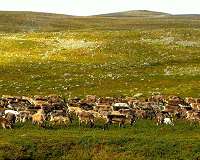
Climate warming reduces the number of plant species in the tundra, but plant-eating animals, such as reindeer and voles, can turn this negative effect into something positive. The results of a study coordinated from Umea University in Sweden are now published in Nature Communications.
"By eating tall and wide-leaved plants, reindeer can increase light availability and thus allow more plant species to co-exist and benefit from warmer conditions," says Elina Kaarlejarvi, post-doctoral researcher at Umea University, who led the study.
Earlier studies suggest that tundra plant diversity will decrease in response to a warmer climate. However, it is important to know whether the response depends on the abundance of grazing animals, particularly reindeer, voles and lemmings, which are very common in tundra ecosystems.
Researchers at Umea University in Sweden, and Oulu University in Finland, tested this through experimental warming of vegetation on tundra meadows with and without reindeer and voles.
"We found that the warming increased the number of species in plots that were grazed, because it enabled small tundra plants to appear and grow there. But when we fenced reindeer, voles and lemmings out, vegetation became denser and the light was limited. As a result, many small and slowly-growing plant species were lost," says Elina Kaarlejarvi.
The researchers investigated what species appeared and disappeared from the study plots over the course of five years. By doing so, they could test what kinds of species were most affected by warming and grazing. The newly published results suggest that mammalian herbivores could generally help protect diversity in warmer climates by preventing losses of small and slowly-growing species.
The study was performed in Kilpisjarvi in northwest Finland, where the research team tested the importance of grazing animals, warming and nutrient availability by combining small greenhouses that increased the summer temperature by 1-2 degrees Celsius, small fences that excluded reindeer, voles and lemmings, as well as by use of fertilization.
Ancient tree exposes cause of hike in Arctic temperature
Scientists from the University of New South Wales have found an ancient kauri tree in New Zealand that holds the key to the cause of rising Arctic temperatures.
The 30,000-year-old kauri tree in a peat swamp in New Zealand showed a new mechanism that could explain how temperatures in the Northern Hemisphere spiked several degrees centigrade within a few decades during the last global ic … read more
