
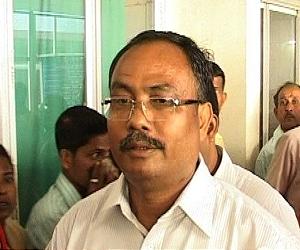
The Indian government and rebels in the northeastern state of Assam are aiming for peace talks after a court released a jailed insurgent leader.
Arabinda Rajkhowa, leader the United Liberation Front of Asom, was greeted by supporters as he left jail in Guwahati, the state capital, where he was held for a year on sedition charges.
Rajkhowa said ULFA was ready to sit down with federal and state government officials to begin peace talks but first more ULFA members must be released from prison.
"We are for unconditional peace talks with the government but a formal decision to this effect could be taken at our executive meeting once all jailed leaders are released," he said.
Rajkhowa, 54, was captured in Bangladesh and handed to Indian authorities last year to stand trial for murder, kidnapping and extortion.
But a thawing in relations with ULFA in the past year has seen six top leaders, including Rajkhowa, released on bail since May. The government hasn't opposed bail requests made by the six senior ULFA members.
Assam is one of several states in the northeast and on the eastern seaboard of the country where separatist groups have been fighting federal government control for 40 years or more.
ULFA was formed as a student movement in 1979 but in the mid 1980s formed contacts with more militant groups for training and buying guns. These included contacts with the Kachin Independence Army and the Nationalist Socialist Council of Nagaland.
The KIA is composed of ethnic Kachins in northern Myanmar's state of Kachin. They claim their traditional territory runs into Yunnan, China, and far-eastern India near Assam.
The NSCN is a Naga nationalist group that wants a self-governing homeland of territory that includes areas in northeast India and Myanmar.
Like many of the insurgent groups, where the ULFA gets its money has been a big concern for government authorities who suspect them of being involved in cross-border drug smuggling, including that of heroin. In 1988, one ULFA leader was caught with around 11 pounds of heroin believed to have originated from Myanmar.
The government of India classifies ULFA as a terrorist group and banned the organization in 1990. The U.S. State Department lists it under "other groups of concern."
ULFA's often bloody incursions against military targets and civilian infrastructure include a January 2007 attack in which 62 Hindi-speaking migrant workers in Assam were killed. An ULFA explosion in 2004 killed more than a dozen people, including school children.
Upon his release, Rajkhowa urged the government to set free more ULFA members.
"I would like to appeal to the government to release two of our jailed colleagues, Sasha Chouhdury and Chitraban Hazarika, immediately," he said.
He also wanted the Indian government assure safe passage for Anup Chetia, ULFA general secretary, to travel from Bangladesh to take part in the peace process.
But Rajkhowa said he "would like to make it very clear that the peace process in no way would bring division or split the ULFA."
Share This Article With Planet Earth
