
This was the first time that OneWeb launched 34 of its satellites. In February 2019, OneWeb successfully launched the first six broadband satellites. OneWeb is building a communications network with a constellation of low-Earth-orbit satellites that will provide connectivity to people around the world.
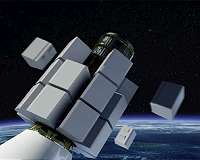
As a key OneWeb supplier, RUAG Space built the satellite dispenser, which functions as an interface between the Soyuz rocket and satellites. The dispenser is tailored to the need of a constellation like OneWeb, being able to deposit up to 36 satellites safely into space.
"Our dispenser is super-light and includes state-of the art technology to safely place the satellites in orbit", says RUAG Space Executive Vice President Peter Guggenbach. "With our products we are contributing to this important project, which will enhance communication around the world."
Starting from the launch in February 2020, the RUAG built OneWeb dispenser will include a conical top structure, a "hat", that has the capability to host up to four additional OneWeb satellites per mission.
With its extensive know how RUAG has developed a unique and cost effective solution that enables OneWeb to maximize the number of satellites per Soyuz launch. The top structure was developed within the contract with Arianespace for the OneWeb program.
RUAG dispensers, produced in Sweden, are especially suitable for spacecraft constellations such as OneWeb, where a high number of spacecraft need to be placed in orbit within a short time frame. At its lower interface the dispenser structure is bolted to the launch vehicle upper stage. Each satellite is attached to the dispenser in separation nodes. The RUAG dispenser provides a stiff connection in each node during launch, a safe release and an accurate separation provided by the four separation nuts and spring units.
"We are proud of our global RUAG Space team who worked collaboratively with our customer to get this mission off the ground, and we are all excited to see the launch of this incredible constellation," says Guggenbach.
Collaborative Product Supplier
RUAG Space manufactures the satellite panels used by OneWeb Satellites in Titusville, Florida. The OneWeb structures (satellite back-bone) are manufactured using the Automated Potting Process (APM).
The APM process-developed by RUAG Space-is a revolutionary production method that uses a pick and place machine to rapidly position special inserts filled with adhesive into the satellite structure's sandwich panels.
In Austria, RUAG Space produced the multi-layer thermal insulation which protects the OneWeb satellites against the cold and heat in space from approx. minus 150 C to plus 150 C (-238 degrees F to 302 degrees F).
The insulation consists of several layers of metal-evaporated polyimide film. RUAG Space in Austria also built handle equipment and containers that OneWeb uses to transport the assembled satellites to the different launch sites as well as the corresponding handling at the launch sites.
The high-tech, custom satellite containers are used to transport the satellites to the worldwide rocket launch centers. The containers are equipped with a specifically designed damping systems and climate-control.
When fully operational, OneWeb will aid the nearly four billion people around the world who currently have no access to reliable internet. The OneWeb project will allow people-particularly in developing and newly industrialized nations-tremendous new opportunities for information, education and economic growth.
