
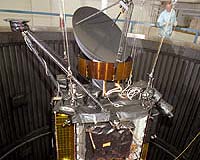
The Quick Scatterometer (QuikSCAT) satellite built by Ball Aerospace and Technologies Corp. completed eight years of outstanding on-orbit operations today, performing six years beyond its minimum two-year mission requirement. QuikSCAT continues to return critical wind data to forecast hurricanes and El Nino effects and pinpoint typhoons and other marine storms, as well as help scientists measure the mass of the Antarctic and Greenland ice sheets.
QuikSCAT data has improved the warning time for tropical cyclone development in the Atlantic and Eastern Pacific hurricane basins. Using wind field data from QuikSCAT, researchers are able to detect potential cyclones in these regions earlier than traditional capabilities allowed. This early detection of storms could allow residents more time to prepare for adverse weather conditions.
"QuikSCAT has clearly demonstrated its reliability to both government and commercial customers, providing quality forecasting data to scientists and meteorologists — the type of data that could easily be extended with a new scatterometer mission," said David L. Taylor, president and CEO of Ball Aerospace.
QuikSCAT is a polar orbiting satellite with an 1800 km wide measurement swath on the earth's surface, circling the earth from a distance of 800 km (500 miles). Generally, this results in 400,000 measurements daily over a given geographic region. The onboard SeaWinds scatterometer has enhanced global climate research by recording sea-surface winds over the oceans on a 25km x 25km spatial scale.
NASA awarded its first Rapid Spacecraft Acquisition fixed-price contract to Ball Aerospace for the QuikSCAT, which was completed in 11 months — an industry record for a spacecraft of its size. The QuikSCAT Ball Commercial Platform (BCP 2000) architecture has since been used for the Ball Aerospace-built QuickBird I and II satellites, the ICESat and CloudSat satellites, and the National Polar-Orbiting Operational Environmental Satellite System Preparatory Project.
Designed to measure ocean winds, SeaWinds has proven useful in many other applications. Earlier this year, it detected the most widespread Antarctic melting ever observed using satellites during the past three decades. In 1999, it detected a mammoth, previously lost iceberg called B10A in the Drake Passage shipping lane. The iceberg is now tracked for the National Ice Center to route supply ships into and out of Antarctica's McMurdo station.
