
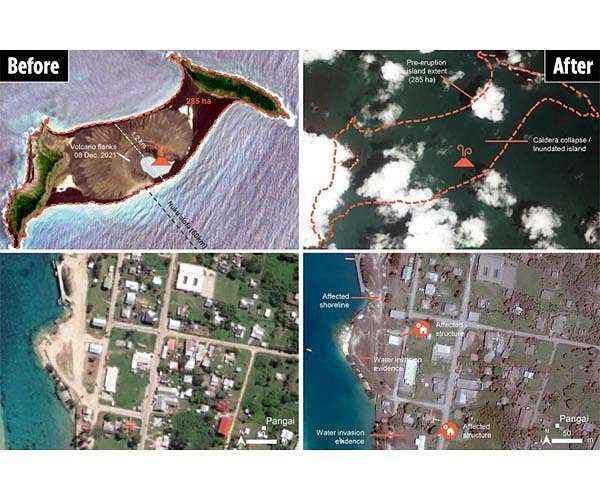
Tongans said they were determined to rebuild their battered homeland in the wake of last week's devastating eruption and tsunami as a massive clean up continued Saturday in the Pacific kingdom.
The powerful eruption of the Hunga-Tonga-Hunga-Ha'apai volcano last Saturday triggered a tsunami that crashed across the Tongan archipelago, affecting more than 80 percent of the population, according to the United Nations.
Tongan journalist Marian Kupu said most locals are adamant on remaining as the huge recovery efforts began.
"We want to stay here in our country because this is what identifies us as Tongans. We want to rebuild our country and unite and move on," Kupu told AFP.
Toxic ash polluted drinking water supplies, crops were destroyed and at least two villages have been completely wiped out.
An estimated one cubic kilometre of material blasted from the volcano, and experts expect Hunga-Tonga-Hunga-Ha'apai to remain active "for weeks to months".
"Tonga's people are going to need sustained support responding to a disaster of this scale," Sione Hufanga, the United Nations Coordination Specialist in Tonga said.
"The people of Tonga are still overwhelmed with the magnitude of the disaster."
Tonga ranks third on the World Risk Report, which measures countries on their susceptibility to experiencing natural disasters.
But, despite the risk, Kupu said most Tongans wanted to stay.
"It's this feeling of pride that we have here, that we don't want to leave the country we were born and raised in," she said.
One survivor from the island of Atata, which was flattened by the tsunami, told her he would return to the island even after the devastation, she added.
"He explained he wished to go back because his parents are buried there, he was born there and his life is there.
"He wished the government or anybody would help rebuild his little island so he could go back."
– 'Unprecedented disaster' –
The New Zealand and Australian defence forces have started delivering urgent relief supplies, particularly water, to Tonga but an Australian minister said fears of unleashing a "Covid crisis" were complicating aid efforts.
Tonga is Covid-free and has strict border control policies, requiring contactless delivery of aid, and a three week quarantine period for any aid personnel who wish to enter the country.
"It's a very, very difficult time for the people of Tonga," Australia's international development minister Zed Seselja said, but added: "We respect absolutely the desire of the Tongan government not to add a Covid crisis to a humanitarian crisis caused by a tsunami."
Meanwhile a third New Zealand navy vessel carrying helicopters, water, tarpaulins, milk powder and engineering equipment is on its way to Tonga and is expected to arrive early next week.
Defence Minister Peeni Henare said all deliveries will be contactless in accordance with Tonga's Covid-19 protocols.
The Tongan government has called the dual eruption-tsunami "an unprecedented disaster" and declared a nearly one-month national emergency.
The eruption broke a vital undersea communications cable linking Tonga with the rest of the world, and it is expected to be at least a month before all communication services are fully restored.
In the meantime partial communications has been established, although mobile network provider Digicel said the high number of calls to the island was producing delays.
UN plans zero-Covid Tonga relief effort
Geneva (AFP) Jan 21, 2022 –
The United Nations said Friday it was adopting zero-Covid methods of delivering badly-needed food, fuel and clean water to Tonga as the volcano and tsunami disaster relief efforts finally get rolling.
UN agencies told reporters in Geneva that now Tonga's main runway had been cleared of ash following Saturday's eruption and the ports were opening, methods of bringing in aid that required no contact with locals were being taken up.
The remote Pacific island nation, home to around 100,000 people, recorded its only Covid-19 case in October and has imposed strict protocols to keep out the virus.
The UN's humanitarian agency OCHA said that incoming relief workers could face weeks in quarantine, so it was focusing on "no-contact delivery".
"There is a very strong message from the government that they will not have Covid coming into the country in this response," spokesman Jens Laerke said.
He said options included planes landing and being unloaded by local crew without anyone on board exiting the aircraft, ships being offloaded by cranes while the crew stayed on board, and helicopters flying out to ships moored offshore.
"These are these options that are all being looked at to ensure that we adhere fully to the protocols," he said.
– Drinking water a 'serious concern' –
Australia and New Zealand sent in the first humanitarian flights on Thursday, five days after the dual disaster cut off the remote kingdom.
World Health Organization spokesman Christian Lindmeier said there were fortunately few casualties and that health installations were operational.
"The most important health needs are the drinking water, food and apparently also fuel to get everything rolling," he said.
"As long as this can be brought in with the contactless efforts, this seems to be fine.
"It looks right now that emergency teams… (are) not necessary at this point."
Laerke said that access to safe drinking water was a "serious concern" for around 50,000 people — roughly half the population — while an estimated 60,000 had been affected by damage to the agricultural sector.
He said the depth of ash cloaking the Polynesian archipelago was worse than initially reported, at about 10 centimetres (four inches).
And while Tongans are cleaning ash away, "there are health concerns with that, because some of that may be toxic".
The World Food Programme said it was readying its resources to go in.
"It would appear all agricultural sectors have been badly affected, from crops to livestock and fisheries. Initial estimates show up to 12,000 agricultural families have been affected," said spokesman Tomson Phiri.
"Roughly 60 to 70 percent of livestock-rearing families are estimated to have been affected.
"It's likely most families could do nothing to protect or save their livestock from perishing and for those that survived, there may be very little grazing pasture and uncontaminated water supplies left."
