
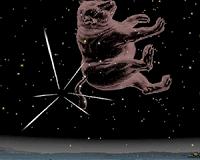
The Quadrantids arrive in the skies each year in the first week of January. The shower often produces an abundance of shooting stars, as many as a 100 per hour during its peak.
For people in North America, that won't be the case this year.
Though intense, the Quadrantids feature only a brief peak. For sky watchers to witness the crescendo of meteors, the timing must be right.
The elusive shower is caused by the trail of debris left by 2003 EH1, an object astronomers think is a rock-comet — almost an asteroid, not quite a comet. As Earth's orbit passes through the debris, the bits of rock and ice collide with the atmosphere and burn up, creating bright streaks in the night sky.
"The reason the peak is so short is due to the shower's thin stream of particles and the fact that the Earth crosses the stream at a perpendicular angle," according to NASA.
For viewers in North America, the Quadrantids will peak at the wrong time relative to Earth's rotation. While viewers in Asia and Europe will witness between 60 and 100 streaking meteors per hour, viewers in the United States and Canada may only see 25.
The meteors will appear low in the sky just above the northern horizon late Thursday night and during the early morning hours on Friday.
"Incoming meteoroids will be mostly blocked from view by the planet Earth," according to Space.com.
Still, those that do appear are likely to be impressive, streaking a long path across the upper atmosphere.
If clouds thwart viewing plans, both NASA and Slooh will provide live streams of the meteor shower.
