
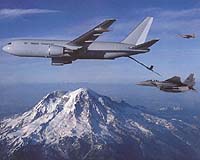
A US air force general said Thursday he hoped an upcoming Pentagon announcement on the winner of a huge aircraft contract will not spark a legal challenge by the loser of the lucrative bid.
"I really hope there is not a protest," said Air Force chief of staff General Michael Moseley, of bidding which has pit US aerospace giant Boeing against Europe's EADS and its US partner Northrop Grumman.
"It's taken so long to do this," Moseley told journalists, adding that a protest could slow down the military's long-delayed modernization of its aging air fleet.
Boeing and EADS-Northrop have battled for more than a year to snare the strategically important contract, the winner of which could be announced as soon as Friday, according to insiders.
But a challenge could further slow the process, the top US air force general said.
"If we get a long protest then we will just still operate 44-year old airplanes longer," Moseley said, adding: "Every month of delay costs you money and time."
"This is not about lawyers and companies. This is about operational capability for the country," he added.
Moseley's remarks came as the Defense Department continued to evaluate the rival bids, with Chicago-based Boeing widely tipped to be in the lead.
Boeing is considered the heavy favorite to win the 40-billion-dollar contract over the next 10 to 15 years to replace the Air Force's 179 aging refueling tankers.
The competition has been closely watched not just because of the enormous size of the contract, but because of the geopolitical implications of the Air Force's choice between a domestic or foreign contractor for its future refueling tanker fleet.
Boeing, defending its position as the leading aircraft supplier for the US military, is proposing a version of its long-haul cargo plane the 767-200.
EADS is promoting a modified version of the Airbus 330 to gain entry into the US defense sector, the world's biggest arms market, particularly crucial at a time when European defense budgets are stagnating.
The winner of the bid will get a cushion that would protect it for decades in case of a downturn in the highly cyclical market for commercial aircraft.
Both proposals involve retooling jetliners late in their commercial life-cycles, either the Boeing 767 or Airbus A330, into rugged freighters built to haul cargo and fuel around the globe.
That means the US Air Force is poised to become the largest airplane customer for either Boeing or Airbus, keeping a production line running at full capacity into the foreseeable future that would otherwise be shuttered.
The victor also could be in pole position for future contracts: the current refueling tankers contract is the first segment of a market valued at 200 billion dollars over 30 years.
Boeing is such an overwhelming favorite that the contract win is already factored into its stock price.
But observers were not entirely counting out EADS, which is known for aggressive pricing, and which has run a spirited campaign with Northrop Grumman.
