
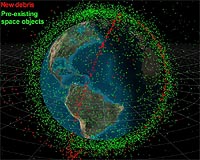
The Pentagon acknowledged Thursday that it did not anticipate the accidental collision in space of a US commercial satellite with a Russian military satellite, the first major event of its kind.
"We did not predict this collision," said Bryan Whitman, a Pentagon spokesman.
The Bethesda, Maryland-based Iridium Satellite LLC announced Wednesday it had lost an operational satellite after a collision Tuesday with a dead Russian satellite.
The US Joint Space Operations Center tracks about 18,000 objects in orbit, so many that it has to decide which to follow most closely, like the International Space Station or manned space flights.
"There are limits on your ability to track and compute every piece of orbiting man made object," said Whitman.
"It's an unfortunate incident that highlights the importance of cooperation and collaboration in space," he said.
Satellites that are "going dead" can be put in a place in space where there is no activity, or maneuvered into a safe descent back to Earth, he said.
But Whitman refrained from accusing the Russians of negligence, saying that some of the procedures for handling dying satellites were introduced long after the satellite's launch in 1993.
He said he had been told that Tuesday's collision was not the first of its kind, adding that "there have been three to four other events."
NASA spokesman John Yembrick said there have been "three other cases in which space objects orbiting at hypervelocity have collided accidentally."
However, the US space agency spokesman added that "these were all minor events involving spent rockets or small satellites with only a few pieces of resulting debris."
Share This Article With Planet Earth
