
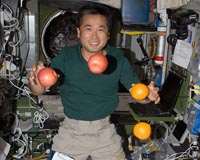
Japan Aerospace Exploration Agency astronaut Koichi Wakata and his space shuttle Endeavour crewmates completed transferring three payloads from a cargo carrier to Kibo's Exposed Facility. This was the first operational use of the Kibo robotic arm.
MAXI, SEDA-AP and ICS all are installed on the Exposed Facility. MAXI is the Monitor of All-sky X-ray Image experiment and SEDA-AP is the Space Environment Data Acquisition equipment – Attached Payload experiment.
ICS is the Inter-orbit Communication System, the Kibo-specific communications system for uplinking and downlinking data, images and voice between Kibo and the Mission Control Center at Tsukuba Space Center by way of Japan's own relay satellite, the Data Relay Test Satellite, or DRTS.
Astronauts Conduct Kibo Robotics Work
Japan's Koichi Wakata will inaugurate the use of Kibo's robotic arm for scientific purposes today to install a trio of components on the station's new "front porch."
today, the Monitor of All-sky X-ray Image experiment will be moved first, then the Inter-orbit Communication System and the Space Environment Data Acquisition Equipment-Attached Payload.
After the robotics are complete, the entire shuttle crew will field questions from television reporters.
While the crew slept, Mission Control updated Friday's spacewalk plan. Mission Specialists Chris Cassidy and Tom Marshburn will swap all four of the remaining Port 6 batteries on the fourth of five spacewalks. In addition, they'll install a camera on the Kibo porch that was deferred from the first spacewalk. Cassidy and Wolf completed two of the battery swaps on the third spacewalk, but had to end the excursion early because of rising carbon dioxide levels in Cassidy's suit.
Share This Article With Planet Earth
