
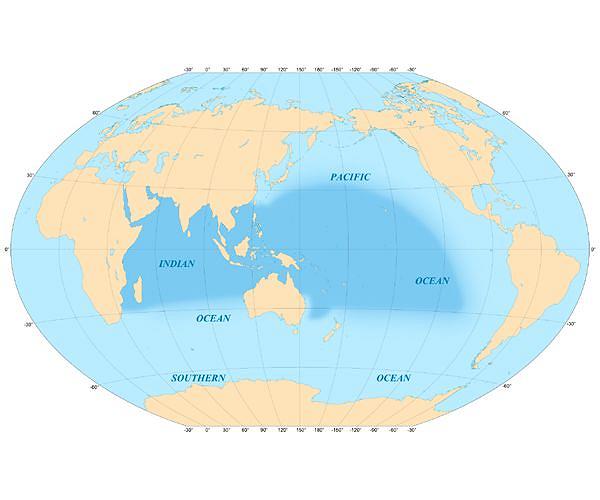
Navy Secretary Kenneth Braithwaite said Tuesday in a speech that he has asked the Navy to establish a new fleet focused on the border between the Indian and Pacific Oceans.
It's not clear how far along the planning process is for the fleet, and Braithwaite — who was appointed by President Donald Trump in March and sworn in in May — has acknowledged that he is likely to be replaced after President-Elect Joe Biden takes office in January.
Braithwaite, speaking to a virtual audience attending a Naval Submarine League conference, also didn't say precisely where the fleet would be located.
"We want to put that numbered fleet in the crossroads between the Indian and the Pacific oceans," Braithwaite said in the speech.
"If we're really gonna have an Indo-Pacom footprint, we can't just rely on the Seventh Fleet in Japan. We have to look to our other allies and partners like Singapore, like India, and actually put a numbered fleet where it would be extremely relevant if — God forbid — we were ever to get in any kind of a dust up," he said.
Braithwaite said the move would be a direct response to Chinese expansionism in the region.
"Most recently I was in a trip to the Far East: every single one of our allies and partners are concerned about how aggressive the Chinese have been. I would argue with anybody that not since the War of 1812 has the United States and our sovereignty been under the kind of pressures that we see today," Braithwaite said.
Biden's likely pick for defense secretary, Michele Flournoy, has also expressed concern about China's growing military might.
"We have to have enough of an edge, that first and foremost we can deter China from attacking or endangering our vital interests and our allies. That means resolve," Flournoy told Defense News.
Air Force, Navy, Marines participate in joint exercise over Indo-Pacific
Washington DC (UPI) Nov 17, 2020 –
A B-1B Lancer participated in a joint interoperability exercise in the Indo-Pacific Region last week, the Air Force announced.
According to the Air Force, a B-1B assigned to the 34th Bomb Squadron at Ellsworth Air Force Base in South Dakota integrated with the 9th Expeditionary Bomb Squadron at Dyess AFB in Texas — currently deployed to Guam — along with other members of the Air Force, Navy and Marines.
The mission lasted about 25 hours and focused on operational-level, joint force movements, specifically involving defense of high value assets, maritime interdiction and airfield seizure.
"Scenarios like these help increase our lethality, readiness, joint force integration, flexibility and agility that can be used in any real-world scenario," U.S. Air Force Lt. Col. Ryan Stallsworth, 9th EBS commander, said in a statement.
"We also had B-1 assets from the continental U.S. participating in the exercise, which demonstrated our bomber force's global reach and long-range strike capabilities," Stallsworth said.
Participating in the exercise allowed aircrews to obtain training that could be imperative in future missions, and improved the capabilities of U.S. military branches working together, according to the Air Force.
"Our aviators have gained priceless experience in a contested and degraded maritime environment where dynamic targeting capabilities and flexibility are critical requirements," Stallsworth said.
"Exercises, like this one, help us develop high end conflict tactics, training and procedures for our Airmen," he said.
