
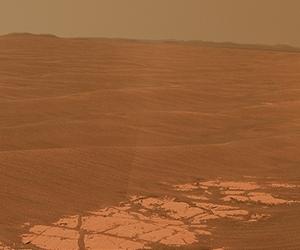
Opportunity took advantage of some exposed rock outcrop to perform an in-situ (contact) science campaign to sample the surface at roughly one-kilometer (0.62-mile) intervals.
On Sol 2315 (July 29, 2010), the rover performed a short 16-meter (52-foot) drive to position herself on exposed outcrop for a weekend science campaign.
On Sol 2317 (July 31, 2010), the robotic arm (instrument deployment device, or IDD) was moved first, so the panoramic camera (Pancam) could image the work volume.
Then the IDD collected a microscopic imager (MI) mosaic of a surface target, called Valparaiso, followed by the placement of the alpha particle X-ray spectrometer (APXS) on the same target for integration.
More remote sensing science was collected on the following sols. On Sol 2320, Opportunity resumed the drive toward Endeavour crater with a 71-meter (233-foot) drive to the southeast.
As of Sol 2320 (Aug. 3, 2010), solar array energy production was 529 watt-hours with atmospheric opacity (Tau) of 0.415 and the solar array dust factor of 0.744.
Total odometry is 21,948.13 meters (21.95 kilometers, or 13.64 miles).
Share This Article With Planet Earth
