
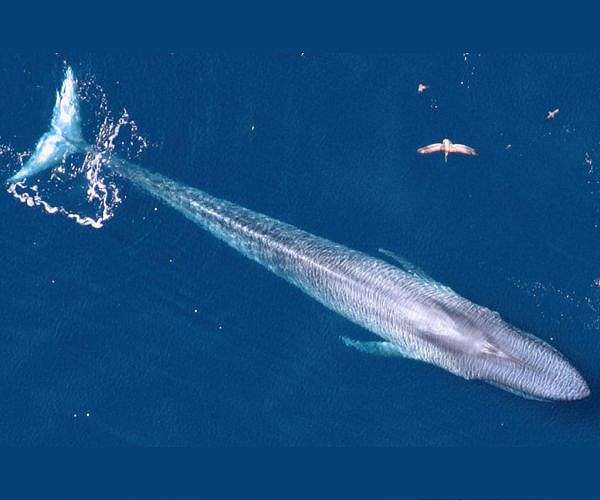
Hunted to the brink of extinction in the 20th century, the Antarctic blue whale population, once estimated at around 200,000, dwindled to just over 300 individuals. By 2004, the numbers remained below 1% of their original size.
Researchers continue to investigate whether the population is rebounding and whether it consists of one unified group or distinct subpopulations – an essential distinction for conservation strategies. In a study published on Nov. 14 in 'Endangered Species Research', University of Washington doctoral student Zoe Rand and her team explored this question using data from historical whaling records and modern modeling techniques. Co-authors of the study include Trevor Branch, a professor of aquatic and fishery sciences at UW, and Jennifer Jackson from the British Antarctic Survey.
Antarctic blue whales, currently listed as endangered, require detailed population structure knowledge for effective conservation. Preserving population-level diversity aids species adaptation to environmental changes and bolsters long-term survival prospects.
The study utilized records from the early 20th century's Discovery Marking Program, where whales were tagged with metal rods to track details such as their location, size, and sex. These markers provided valuable data when the tagged whales were recaptured, although the information had not been previously analyzed for population structure insights.
Rand's team integrated these historical data with contemporary survey results in Bayesian models to assess whale movements across the Southern Ocean's Atlantic, Indian, and Pacific sectors. The findings indicated that whales frequently moved among these basins, suggesting that they form a single, connected population.
The results aligned with acoustic studies that have detected only one type of song among Antarctic blue whales, contrasting with the multiple song types observed in different pygmy blue whale populations. Genetic studies further confirmed that Antarctic blue whales are more genetically similar than separate populations would be.
This study marks the first instance of using Discovery Marking Program data in modern quantitative analysis, providing a potential template for future research on other species such as fin and sei whales.
Despite these findings, mysteries remain. Differences in breeding habitats or migration timing could still indicate subpopulation structures, although little is known about Antarctic blue whale breeding behavior. According to the researchers, combining historical whaling data with current techniques like satellite tagging and photo-identification is crucial to uncovering more about this colossal species.
Research Report:High historical movement rates of Antarctic blue whales on Southern Ocean feeding grounds estimated from Discovery mark data
