
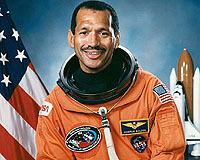
President Barack Obama has named Charles Bolden as NASA administrator, the White House announced Saturday, making him the first African American and only the second ex-astronaut to lead the agency.
Obama also announced his plan to nominate his campaign space advisor, Lori Garver, as Deputy Administrator of NASA.
"These talented individuals will help put NASA on course to boldly push the boundaries of science, aeronautics and exploration in the 21st century and ensure the long-term vibrancy of America's space program," Obama said in a statement.
The announcement comes at a time of rising costs and flagging public enthusiasm for the space mission.
And Bolden, a retired Marine Corps general, could encounter questions about his past connections to corporations involved in major NASA rocket contracts, media reports have said.
If confirmed by the Senate, as seems likely, his appointment would be the culmination of a career that has taken him to the heights of the US space and military establishments from a childhood in the segregated US south. He was born in Columbus, South Carolina August 19, 1946.
He won admission to the US Naval Academy where he was voted president of his graduating class of 1968.
As a Marine Corps fighter pilot, he flew combat missions over North and South Vietnam, Cambodia and Laos during the Vietnam War.
He graduated from the US Naval Test Pilot School at Patuxent River, Maryland in 1979 and the following year was selected as an astronaut by NASA.
Bolden, 62, held several technical and administrative posts at the space agency, including that of assistant deputy administrator at NASA headquarters in Washington.
His first space flight was as a pilot on board the space shuttle Columbia.
Bolden piloted the Discovery shuttle that deployed the Hubble space telescope in 1990, and commanded two further shuttle missions, including a historic first joint US-Russian mission on Discovery in 1994.
That same year, he left NASA to return to active duty in the Marines, rising to the rank of major general and deputy commander of US forces in Japan before his retirement in 2003.
Share This Article With Planet Earth
