
Tomorrow, Sept. 21, 2012, will mark 100 days since NASA's Nuclear Spectroscopic Telescope Array, or NuSTAR, launched into space from the L-1011 "Stargazer" aircraft.
Since completing its 30-day checkout, the telescope has been busy making its first observations of black holes, super-dense dead stars and the glowing remains of exploded stars.
In this early mission phase, the NuSTAR team has been getting to know their telescope better and learning how to point it precisely at targets of interest.
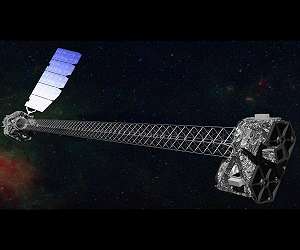
NuSTAR has the longest mast of any astronomical telescope ever launched. The 33-foot (10-meter) flexible structure is part of the mission's innovative design, allowing NuSTAR to focus high-energy X-rays into sharp images for the first time.
The team has been spending time understanding the mast's mechanics and how they affect the telescope's pointing.
In addition, NuSTAR has continued to team up with other observatories, including NASA's Chandra and Swift telescopes, to make coordinated observations.
These joint observations allow astronomers to interpret data from their telescopes more precisely, and to gain a better overall understanding of some of the most extreme events in the cosmos.
