
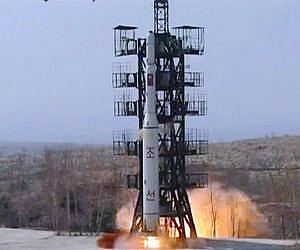
North Korea launched a long-range rocket on Wednesday, in defiance of UN sanctions threats over what Pyongyang's critics insist is a disguised ballistic missile test.
"It (the rocket) has been launched," a South Korean defence ministry spokesman told AFP without elaborating further.
The Yonhap news agency, citing a government source, said the rocket had taken off from the Sohae satellite launch centre at 9:51 am (0051 GMT) and was immediately detected by navy vessels deployed by Seoul in the Yellow Sea.
There was no immediate report on the success of the launch, but the Japanese government said the missile had passed its southern island chain of Okinawa around 12 minutes after take-off.
"The missile that North Korea calls a satellite passed over Okinawa around 10:01 (am). We launched no interception," it said.
Japan had deployed missile defence systems to intercept and destroy the rocket if it looked set to fall on its territory.
The United States had also deployed ships from its Pacific fleet equipped with ballistic missile defences.
Yonhap said the three-stage rocket's first stage had separated as scheduled and splashed down in the sea off South Korea's southwest coast.
In Seoul, President Lee Myung-Bak called an emergency meeting of his National Security Council to discuss the implications of the launch.
Japan's government found the launch intolerable, chief government spokesman Osamu Fujimura said.
"It is extremely regrettable that North Korea went through with the launch despite our calls to exercise restraint," he said.
The launch followed reports in the South Korean media and satellite imagery analysis by US experts that suggested the rocket had been removed from the launch pad to repair an apparent technical problem.
North Korea had originally provided a December 10-22 launch window, but extended that by a week on Monday when a "technical deficiency" was discovered in the first-stage control engine.
North Korea last attempted to launch its three-stage Unha-3 carrier in April, but the rocket exploded shortly after take-off.
A successful launch this time would carry profound security implications, marking a major advance in the North's bid to mate an intercontinental ballistic missile (ICBM) capability with its nuclear weapons programme.
Washington and its allies insist the launch is a disguised ballistic missile test that violates UN resolutions triggered by Pyongyang's two nuclear tests in 2006 and 2009.
In 2006 the Security Council imposed an embargo on arms and material for ballistic missiles and weapons of mass destruction. It also banned exports of luxury goods and named individuals and companies to be subject to a global assets freeze and travel ban.
In 2009, it imposed a ban on North Korea's weapons exports and ordered all countries to search suspect shipments.
The United Nations and European Union had joined calls for Pyongyang to cancel the mission and warned of more sanctions if it pushed ahead.
According to Japanese reports, Japan, the United States and South Korea have agreed to demand the Security Council strengthen sanctions on North Korea to levels that match those on Iran.
That would include increasing the list of financial institutions, entities and individuals subject to asset freezes.
The North's decision to launch the rocket in winter has led analysts to suggest a political imperative behind the timing, which may have overruled technical considerations.
New leader Kim Jong-Un was believed to be extremely keen that the launch fell around the first anniversary of the death of his father and former leader Kim Jong-Il on December 17.
Russia had joined the calls for Pyongyang to cancel the mission, while China, North Korea's sole major ally and its biggest trade partner and aid provider, had expressed concern.
Chronology of North Korean missile development
Seoul (AFP) Dec 12, 2012 –
North Korea on Wednesday launched a long-range rocket which Japanese authorities said passed over its southern island chain of Okinawa. It was the second launch this year, after a failed attempt in April.
North Korea has said the rocket is aimed at putting a satellite in orbit, but much of the international community sees the launch as a thinly veiled ballistic missile test, banned by UN resolutions.
These are key dates in the reclusive nation's missile programme:
Late 1970s: Starts working on a version of the Soviet Scud-B (range 300 kilometres or 186 miles). Test-fired in 1984
1987-92: Begins developing variant of Scud-C (500 km), Rodong-1 (1,300 km), Taepodong-1 (2,500 km), Musudan-1 (3,000 km) and Taepodong-2 (6,700 km)
Aug 1998: Test-fires Taepodong-1 over Japan as part of failed satellite launch
Sept 1999: Declares moratorium on long-range missile tests amid improving ties with US
July 12, 2000: Fifth round of US-North Korean missile talks ends in Kuala Lumpur without agreement after North demands $1 billion a year in return for halting missile exports
Dec 2002: 15 North Korean-made Scuds seized on Yemen-bound ship
March 3, 2005: North ends moratorium on long-range missile testing, blames Bush administration's "hostile" policy
July 5, 2006: North test-fires seven missiles, including a long-range Taepodong-2 which explodes after 40 seconds
July 15, 2006: UN Security Council adopts Resolution 1695, demanding halt to all ballistic missile activity and banning trade in missile-related items with the North
Oct 9, 2006: North conducts underground nuclear test, its first
Oct 14, 2006: Security Council approves Resolution 1718, demanding a halt to missile and nuclear tests. Bans the supply of items related to the programmes and of other weapons
April 5, 2009: which flies over Japan and lands in the Pacific, in what it says is an attempt to put a satellite into orbit. The United States, Japan and South Korea see it as a disguised test of a Taepodong-2
April 13, 2009: UN Security Council unanimously condemns launch, agrees to tighten existing sanctions. North quits nuclear disarmament talks in protest and vows to restart its plutonium programme
May 25, 2009: North conducts its second underground nuclear test, several times more powerful than the first
June 12, 2009: Security Council passes Resolution 1874, imposing tougher sanctions on the North's atomic and ballistic missile programmes
July 4, 2009: North test-fires seven ballistic missiles off its east coast
Feb 18, 2011: Satellite images show the North has completed a launch tower at its new west coast missile base at Tongchang-ri, experts say
May 15, 2011: North Korea and Iran are suspected of sharing ballistic missile technology, according to a UN sanctions report, diplomats say
March 16, 2012: North Korea announces it will launch a long-range rocket between April 12-16 to put a satellite into orbit
April 13, 2012: Rocket is launched from the Tongchang-ri base but disintegrates soon after blast-off and falls into the ocean
December 1, 2012: North Korea announces it will launch another rocket in December, triggering condemnation from its foes and concern from ally China
December 9, 2012: Pyongyang says the launch may be delayed, as analysts say technical problems or snow may be hampering preparations
December 12, 2012: North Korea launches the multi-stage rocket. Japan says it passed over its southern island chain of Okinawa but it did not attempt an interception
