
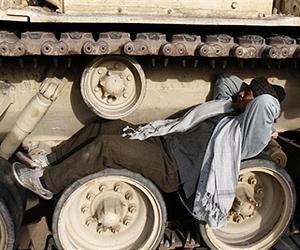
Life began to return to the streets of Cairo on Sunday as banks and shops opened after nine days and the army stepped up its presence around Tahrir Square, epicentre of anti-regime protests.
As demonstrators staged a 13th day of protests against Egypt's President Hosni Mubarak, banks began to reopen, and streets that have been nearly devoid of traffic filled up with vehicles, causing traffic jams.
"Thank God. Over the past 10 days I was hardly earning enough to pay for petrol and my shisha (water pipe)," said a taxi driver, adding he bought his brand-new car five days before the protests started.
"I pay a monthly installment of 2,000 Egyptian pounds (341.9 dollars)," he lamented.
Workers at a McDonald's outlet in the Dokki district scrubbed down front windows that had been whitewashed after the outbreak of demonstrations and the sudden absence of police, which triggered a wave of looting.
"We'll open in half an hour," said an employee as others hurriedly mopped the floor.
Traffic jams returned to the traditionally crowded streets of Cairo, a city of around 20 million people, and the air was once again full of the sounds of car horns as people went back to work.
Police, who disappeared from Cairo's streets after violent clashes with demonstrators, had also returned, manning street corners and traffic circles.
With their return, the so-called popular committees that have been standing guard in residential neighbourhoods to protect against looters had been noticeably reduced in areas toured by AFP reporters.
Banks reopened across the city, and Egyptians queued to access their accounts. The central bank has limited daily personal cash withdrawals to 50,000 Egyptian pounds or $10,000.
Some 150 people queued outside an HSBC branch in Giza.
"People want to withdraw money. This is the only branch open in the area," explained a customer waiting outside. "We will not be able to get in before tomorrow," shouted another. Banks are shut at 1:30 pm (1130 GMT).
State television showed more people queuing outside banks or shopping in well-stocked grocery stores, emphasising that life goes on and allowing interviewees to complain only about the price of vegetables and meat.
Behind the makeshift barricades surrounding Tahrir Square, protesters voiced determination to stay put, while the landmark Mugamaa building, which houses the sprawling main government administration offices, remained shut.
The gate leading to the plaza of the centre was manned by a handful soldiers, while protesters continued streaming into the square outside.
Shops and restaurants around the square remained shut, as did the shops in the streets leading into it, which have seen fierce clashes between protesters and partisans of Mubarak over the past week.
At the edge of Tahrir, the military deployed soldiers close to the Egyptian Museum, but left in place barricades set up by anti-Mubarak protesters, while some demonstrators sat around tanks to prevent them from moving.
Demonstrators fear that if the army departs they could face new attacks by regime supporters or that military movement could be a prelude to attempts to clear them from the central square.
"It is now clear that it was not us who paralysed the country," said Scottish-born film actor Khalid Abdalla, who starred in "The Kite Runner" and has been in the square since the protests started.
"It was not us who shut the banks, or imposed the curfew. True, we are occupying a vital part of the city, but it is his responsibility," said Abdalla, who is of Egyptian heritage, referring to Mubarak.
earlier related report
Iraq PM: Egyptians have a right to democracy
Baghdad (AFP) Feb 5, 2011 –
Iraq's prime minister told AFP on Saturday that Egyptians have the right to democracy, after nearly two weeks of deadly protests in Egypt demanding that President Hosni Mubarak step down.
"I wish the Egyptian people to achieve democracy and partnership," Nuri al-Maliki said in an interview.
"The people have the right to express what they want without being persecuted or prevented from their right to express themselves," the prime minister said.
His comments came as international calls for Mubarak's resignation grew louder.
US President Barack Obama on Friday hinted that the veteran leader should step down, saying the "patriot" should "listen to what is being voiced by the Egyptian people."
Maliki, whose country's longtime dictator Saddam Hussein was ousted in a 2003 US-led invasion, said that for a leader to rule for three decades — as Mubarak has done — was not democracy.
"One of the characteristics of a lack of democracy could be when a leader rules for 30 or 40 years," Maliki said. "It is a difficult issue for people, may be intolerable, and change is necessary," he added.
Maliki said his advice to Egyptians was to eschew violence, and that the country's leaders should not consider giving up power as a defeat.
"Our advice to the people is practise your right without sabotage and violence and destruction to your country because it is your country," the Iraqi leader said.
"Our advice to officials is, don't consider it a defeat when you give an opportunity to others and give your positions — your country needs this development."
In a 12th day of protests in Cairo on Saturday, gunfire crackled on the square where thousands spent a chilly night encircled by tanks.
Ferocious clashes between Mubarak loyalists and the protesters on Wednesday and Thursday left at least eight people dead and more than 800 hurt. Egyptian journalist Ahmed Mohammed Mahmud died on Friday of gunshot wounds.
According to UN estimates, more than 300 people have been killed since the protests began.
Share This Article With Planet Earth
