
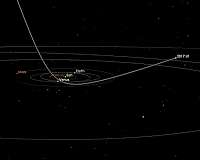
No alien signals have been detected from an interstellar, cigar-shaped space rock discovered travelling through our Solar System in October, researchers listening for evidence of extraterrestrial technology said Thursday.
The object, dubbed Oumuamua, was spotted by several Earthly telescopes two months ago.
Given its weird trajectory, surprised researchers immediately concluded it was from beyond our planetary system — the first interstellar object ever identified in our midst.
The rock is thought to be about 400 metres (1,300 feet) long, and thin — only about 40 m wide, a never-before-seen shape for an asteroid.
After its discovery was announced last month, a project called Breakthrough Listen, dedicated to finding signs of extraterrestrial intelligence, said it would study the rock for artificial signals.
"No such signals have been detected" by its network of telescopes, the project said Thursday, adding: "the analysis is not yet complete".
Oumuamua is a Hawaiian name meaning "messenger" or "scout". This scout may have been travelling through space for hundreds of millions, even billions, of years.
Prior to its discovery, none of the 750,000-odd known asteroids and comets in the Solar System were thought to have originated elsewhere.
"Oumuamua is most likely an asteroid, ejected from its host star in some chaotic event billions of years ago, and finding its way to our Solar System by chance," Andrew Siemion of the University of California Berkeley told AFP. He heads the Breakthrough Listen laboratory.
According to NASA, the object is travelling at about 38.3 kilometres per second relative to the Sun. It is about 200 million kilometres (125 million miles) from Earth.
It passed Mars' orbit in November, and will pass by that of Jupiter in May next year, before exiting beyond Saturn's orbit in January 2019.
15 Fast Radio Bursts Detected from Distant Universe
Breakthrough Listen – the initiative to find signs of intelligent life in the universe – has detected 15 fast radio bursts emanating from the mysterious "repeater" FRB 121102. Fast radio bursts, or FRBs, are brief, bright pulses of radio emission from distant galaxies. First detected with the Parkes Telescope in Australia, FRBs have now been seen by several radio telescopes around the world. FRB … read more
