
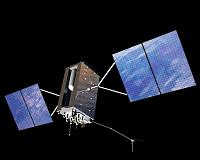
The U.S. Air Force is set to launch its newest GPS satellite from Cape Canaveral Air Force Station, Fla., on Thursday morning.
It's the second in a new, third generation of GPS satellites for the nation, designed and built by Lockheed Martin to be more accurate with more protection against signal jamming.
Liftoff aboard a United Launch Alliance Delta rocket is planned for 9 a.m., with a 27-minute launch window in case of delays.
Since GPS is for navigation, and the satellite will circle the globe, it was named Magellan after the 16th-century explorer credited with first circumnavigation of the world.
"It's more powerful … with a robust design that will extend the spacecraft's lifespan," said Col. Thomas Ste. Marie with the Air Force's 45th Space Wing.
The Air Force has forecast an 80 percent likelihood of favorable weather for the launch, and 70 percent favorable conditions the next day if a delay is necessary.
Like previous models, the latest satellites also share compatibility – for certain functions – with the systems of other nations, including Russia and members of the European Union. Along with China, those other systems were developed not to be dependent on the U.S. system.
The nation's GPS system, first developed for the military, is now available at no cost to the private sector, since it was built with taxpayer dollars, said Rick McElroy, head of security strategy for cybersecurity firm Carbon Black.
"I think GPS is good, but there will probably be something better than GPS. It's going to be massively saturated soon when you have all the robots, drones and self-driving cars on it," McElroy said.
The next several GPS III satellites are in production at Lockheed Martin's plant in Waterton, Colo. A total of 10 are ordered, with one in orbit.
Lockheed is working to lower the cost of the satellites as it builds more, said Johnathon Caldwell, vice president of navigation systems at Lockheed Martin.
"By satellite number 10, the cost will be $200 million," Caldwell said. "The volume of satellites being made at Waterton plant allows for tremendous efficiencies."
The launch will be the 29th and final flight of ULA's Delta IV Medium rocket and the 73rd GPS launch in history. ULA is working on a new family of rockets, the Vulcan Centaur.
