
Anna Ijjas, leader of the recently established Lise Meitner Research Group "Gravitational Theory and Cosmology" at the Max Planck Institute for Gravitational Physics (Albert Einstein Institute / AEI) in Hannover, and Paul Steinhardt, Albert Einstein Professor in Science at Princeton University, receive 1.3 million US-dollars for four years from the Simons Foundation.
The goal of the newly funded initiative "New Directions in Cosmology and Gravitational Theory" is to develop and test theories of the origin, evolution, and future of the universe that challenge the standard view that the universe began with a big bang about 14 billion years ago. Ijjas' group at the AEI Hannover receives 500,000 US-dollars that she will use towards building her research team, including support for graduate students and postdocs, workshops, conferences, and visitors.
"I am delighted that the Simons Foundation chose to fund our proposal. The timing could not be better. With this new grant, I can optimally leverage the already generous start-up funds I was provided by the Max Planck Society's Lise Meitner Excellence Program," says Anna Ijjas, leader of the Lise Meitner Research Group "Gravitational Theory and Cosmology" at the AEI Hannover. "My ultimate goal is to make the Albert Einstein Institute in Hannover even more visible as a worldwide center for gravitational theory and cosmology research."
Ijjas works on the big open questions of cosmology, such as the origin and evolution of the universe, its composition, and future fate, as well as the implications for gravitational theory in other situations involving space-time singularities, such as black holes. Her Lise Meitner group combines novel theoretical ideas and concepts with modern techniques of mathematical and numerical general relativity.
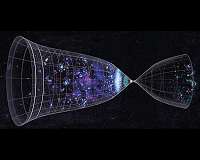
"According to the new paradigm that we want to formulate and test observationally, the universe did not begin with a big bang," explains Ijjas. "It rather 'bounced' from a previous period of contraction to the current phase of accelerated expansion we see today. It may even be that space-time is eternal, driven through regular cycles of expansion, contraction and bounce by what we call 'dark energy' today."
The initiative will bring together a small international team of leading theorists in a focused effort at the AEI in Hannover and at Princeton University. Major mathematical and physical advances could be achieved by the team in the coming years – which is also when the cosmological and astrophysical observations become available to test the predictions of these new theories.
"I firmly believe there is a chance for a major breakthrough that will fundamentally change our understanding of the origin and future of the universe," says Ijjas.
The Simons Foundation, established in 1994, is a private foundation based in New York City that funds research in mathematics and basic sciences. The funding granted to Ijjas and Steinhardt is part of the foundation's "Targeted Grants in Mathematics and the Physical Sciences" program, which "is intended to support high-risk projects in mathematics, theoretical physics and computer science of exceptional promise and scientific importance."
