
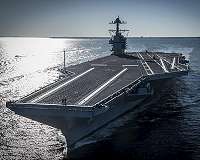
The U.S. Navy is relying on an independent team of government and outside experts for a "full court press" to overcome problems with the advanced weapons elevators aboard the newly constructed aircraft carrier Gerald R. Ford.
Only two of Ford's 11 elevators, which are run with electromagnetic, linear synchronous motors, are operational. They allow for greater capacities and a faster movement of weapons than the Nimitz-class carrier elevators, which utilize cables, and are expected to reduce required manning, maintenance and total ownership cost.
"We have a full court press on the advanced weapons elevators," James Geurts, assistant secretary of the Navy for research, development and acquisition, said in a news release. "We've gathered a team of experts on the carrier right now, which will work with the shipbuilder to get Ford's weapons elevators completed in the most efficient timeline possible. They will also recommend new design changes that can improve elevator activities for the rest of the Ford class."
Two weeks ago, the Navy-led team arrived on the carrier, which is undergoing sea trials. They formed an integrated approach among Huntington Ingalls Industries' Newport News Shipbuilding, the government, Ford crew and industry experts.
The team includes specialists in their respective fields, and many have had a number of successes at solving developmental technological challenges, the Navy said.
"This team of experts in electromagnetic systems, fabrication and production control, software, systems integration, and electrical engineering will focus on completing the production of the remaining elevators on CVN-78 and recommending design changes for future ships in the class," Geurts said. "In doing so, they will execute corrective actions and adapt best practices to ensure the completion of the advanced weapons elevators in support of the USS Gerald R. Ford's operations."
Ongoing construction problems include "very tight tolerances, physical structural adjustments and software refinement" necessary for the weapons to be moved reliably, Capt. Danny Hernandez told Navy Times
"Doors and hatches have to be moving in the right sequence and as you'd expect," Hernandez said. "They have to be aligned. Mr. Geurts feels once we get the uppers and lowers working, it's just a matter of improving efficiency."
The ship's weapons department has been training on the two functioning elevators.
"The two upper stage elevators have absolutely operated as designed," said Lt. Cmdr. Chabonnie Alexander, Ford's ordnance handling officer. "We operate the elevators 10 times a day, five days a week, and ship's force subject matter experts continue to get smarter and more comfortable each day with the system and its operating capabilities. Additionally, as we become more comfortable and more proficient with the elevators we're also becoming better able to anticipate and diagnose any technical issues that may arise."
With the elevators, up to 24,000 pounds of ordnance can be moved at 150 feet-per-minute. On the Nimitz-class carriers, it's 10,500 pounds at up to 100 feet-per-minute.
The Navy is in the process of constructing a land-based test site at Naval Surface Warfare Center Division Philadelphia for the production, test and delivery of system components with completion estimated for next year.
In addition, the Navy and shipbuilder are completing a digital twin co-located at the shipyard facility in Newport News to be complete this fall.
The Ford is scheduled to be delivered to the Navy in mid-October and deployed sometime next year. The ship was formally commissioned into the Navy on July 22, 2017.
The ship, designated as CVN 78, has encountered years of delays and cost overruns for the first new design for an aircraft carrier since the Nimitz-class debuted in 1975.
Follow-on ships in the class already under construction are the John F. Kennedy and the Enterprise, with planning for the unnamed CVN 81 in progress.
The Navy plans to spend $43 billion on the three new ships.
Last month, Huntington Ingalls was awarded a five-year $687 million contract for early service life period work on the Ford.
Norfolk Naval Shipyard breaks ground on production training facility
Washington (UPI) Jul 2, 2019 –
Norfolk Naval Shipyard conducted a groundbreaking ceremony for a 157,000-square-foot, $64.7 million production training facility.
Training currently spread across 26 different locations and eight departments will be consolidated in one complex in Portsmouth, Va. The complex is one of the largest shipyards in the world specializing in repairing, overhauling and modernizing ships and submarines
"In establishing this large, modern and consolidated training facility, we will provide a hub for the shipyard's academic classrooms and on-the-job training areas, allowing theory and application to meet," Shipyard Commander Capt. Kai Torkelson said at the groundbreaking Monday. "Supporting those efforts, this facility will also house administrative offices, conference rooms, training aid storage areas, and other support spaces. Innovation, collaboration and knowledge sharing will now transpire all under one roof, and streamlined to benefit our people."
RQ Construction designed the facility and will begin the two-year construction project this month.
Included will be 82 academic classrooms and 26 mock-up areas. Personnel are in radiological controls, quality assurance, nuclear and non-nuclear engineering, planning, production and operations, and lifting and handling.
In addition, the complex will support future training requirements associated with Gerald R. Ford-class carriers and Virginia-class submarines.
The facility will offer instruction in pipefitting, welding, crane and rigging, and motor and generator repair.
The complex will include the sail salvaged from USS La Jolla, which is finishing up its conversion at the shipyard from an operational fast-attack submarine into a moored training ship.
The shipyard plans to become the NAVSEA corporation's sole Sail Learning Center using this 76,000-pound centerpiece. Rather than serving as a monument, La Jolla's sail will become a mockup to train such skills as hull cuts, piping, staging and painting.
"We're trying to be unique and forward thinking here," Sail Learning Center Manager Steve Smith said. Although it's a Los Angeles class sail, it can be adapted to train on Virginia-class submarines, he said.
Norfolk Naval shipyard is the Navy's oldest and largest industrial facility.
"While NNSY can dry-dock, overhaul and repair any ship in the U.S. fleet, it can also perform any technical, fabrication, manufacturing and engineering work your organization might need accomplished," according to the Navy. "In fact, NNSY is known for tackling jobs never before performed, and applying unique planning methods and work procedures through modern process improvements."
Huntington Ingalls Industries, which is the largest military shipbuilding company in the country, is based 20 miles north in Newport News as part of Hampton Roads region.
Naval Station Norfolk has the world's largest concentration of U.S. Navy forces through 75 ships alongside 14 piers and with 134 aircraft and 11 aircraft hangars, according to Military.com.
