
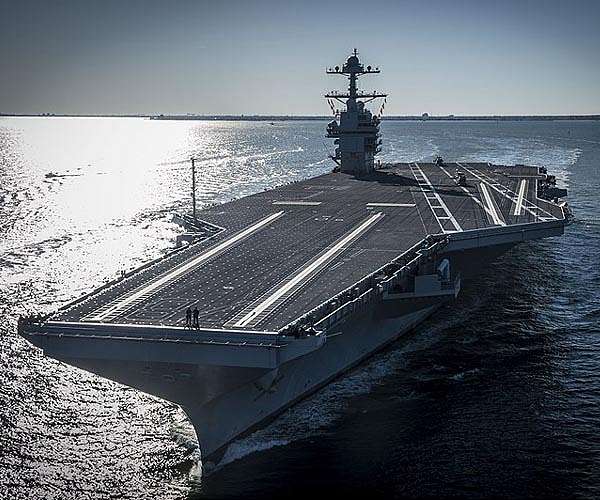
Naval aviators assigned to the "Gladiators" of Fleet Replacement Squadron Strike Fighter Squadron 106 qualified on board the USS Gerald Ford using Precision Landing Mode for the first time, the Navy announced.
Carrier Strike Groups have been using PLM, a new, safer flight control technology, which is also intended to increase training efficiency by reducing the number of in-flight instrument corrections needed before landing, since 2017.
But this week marks the first time pilots have become carrier-qualified while using the technology, the Navy said on Monday.
"The pilots still have to fly the landing pattern around the ship and control the line-up, but with PLM, the glide slope control is smoother, and deviation is much smaller, making for a much safer landing qualification," said Rear Adm. John Meier, Commander Naval Air Forces Atlantic.
"The improved wave-off characteristics make PLM inherently safer for the aircraft carrier," said Meier.
About 25 student aviators became carrier-qualified with the technology this past weekend off the coast of Key West, Fla.
PLM was first developed as part of the Maritime Augmented Guidance with Integrated Controls for Carrier Approach and Recovery Precision Enabling Technologies, or MAGIC CARPET, program, and was first tested in the Super Hornet in April 2015.
The Navy didn't teach start teaching new pilots the landing tool until after the most recent software update, which streamlined the landing process further.
"I first heard about PLM seven years ago and to be quite honest, it sounded too good to be true," said Ford's Commanding Officer, Capt. J.J. Cummings, who has used PLM to land F/A-18Fs on the carrier.
"I now have about 20 traps on Ford using PLM, and it is as good as advertised. In fact, it is straight up amazing. I was fortunate to get eight traps this underway and found that using PLM really stabilized the jet and significantly reduced the amount of corrections I was making during the approach," Cummings said.
