
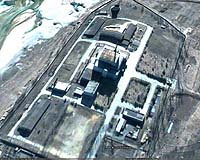
North Korea has increased activities around a plant which can produce weapons-grade plutonium but does not seem to have restarted it yet, a report said Wednesday.
The plant was shut down under a six-nation nuclear disarmament deal.
But the North, angry at UN Security Council condemnation of its April 5 rocket launch, has announced it is quitting the pact and would restart the reprocessing of spent fuel rods to acquire plutonium.
It has also vowed to conduct a second nuclear test and ballistic missile tests unless the UN apologises and retracts its plan to tighten sanctions.
Since the North's first nuclear test in 2006 South Korea has placed hi-tech systems along the border to detect nuclear activities.
US satellite pictures show truck movements around the reprocessing plant at the Yongbyon nuclear complex, Yonhap news agency quoted a source as saying.
"However, our krypton detector has not shown any signs that North Korea has restarted reprocessing," the source told Yonhap.
It was unclear whether the truck movements were related to work to restart the plant, the source said.
South Korea had to wait more than a fortnight before it could confirm the North's first nuclear test on October 9, 2006.
It later announced plans to buy high-tech systems from Sweden and Germany that can detect minute atmospheric traces of certain gases including krypton which are released by reprocessing or by a nuclear test.
Baek Seung-Joo, of the Korea Institute for Defence Analyses, said North Korea already had enough plutonium to conduct a second nuclear test any time, without reprocessing spent fuel rods now in storage.
He told AFP a second test was "a matter of time" if the North also had a device to trigger such an explosion.
The North reportedly put the size of its plutonium stockpile at 31 kilograms (68 pounds) when it handed over a nuclear declaration in June 2008.
Share This Article With Planet Earth
