
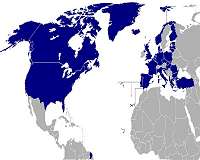
NATO insisted Friday that every member state is covered by its "all for one, one for all" collective defence pledge, after US President Donald Trump appeared to undercut the alliance's core commitment.
Trump added to the uproar over his summit with Russian counterpart Vladimir Putin when he said on Tuesday that the people of the tiny Balkan nation of Montenegro were "aggressive" and capable of triggering World War III.
In that case, would it be reasonable to go to their defence, a Fox News journalist asked the president.
"I understand what you're saying. I've asked the same question," Trump answered.
The president's comments were in line with his overall "America First" strategy and with longstanding US doubts about the wisdom of coming to the rescue of smaller, troublesome allies in Europe at the risk of triggering a wider conflict.
A NATO official speaking to AFP made no direct reference to the controversy over Montenegro but noted that at a NATO summit in Brussels last week, Trump had re-stated Washington's commitment to the alliance.
"NATO's collective defence clause, Article 5, is unconditional and iron-clad. It means that an attack on one is an attack on all," said the official who asked not to be named.
"President Trump has made clear that the US is fully committed to NATO and our alliance is strong," he said.
"Article 5 has only been invoked once, in support of the US after the 9/11 attacks.
"This led to NATO's largest ever operation, in Afghanistan, where hundreds of thousands of soldiers from Europe, including from Montenegro, as well as Canadians, have stood shoulder to shoulder with US troops and more than a thousand have paid the ultimate price," the official added.
Montenegro joined NATO last year, cementing its turn towards the West away from Russia's vision for what Moscow sees as its traditional sphere of influence in the Balkans.
Montenegro says 'contributes to peace' in response to Trump attack
Podgorica, Montenegro (AFP) July 19, 2018 –
Montenegro on Thursday defended its contribution to peace in response to US President Donald Trump, who said the tiny Balkan nation's "aggressive" people were capable of triggering "World War III".
The rebuttal comes after Trump drew criticism in the US with his broadside on Tuesday, which many interpreted as the latest sign of the president's shaky commitment to the NATO alliance, which tiny Montenegro joined only last year.
In a statement on Thursday, Montenegro's government defended its history of "peaceful politics," saying the country "contributes to peace and stability not only on the European continent but worldwide, along with US soldiers in Afghanistan."
It added that Montenegro has served as a "stabilising" force in the region, which was ravaged by wars during the break-up of the former Yugoslavia in the 1990s.
As members of the Yugoslav army, Montenegro's soldiers fought alongside Serbs in Croatia's war of independence. But, like Macedonia, its decision to split from the federation did not trigger a separate war.
Montenegro's alliance with the US remains "strong and permanent," the government added.
Trump made his controversial comments during a Fox News interview on Tuesday in response to a question about NATO's Article 5, which states that an attack on one member is an attack on all.
"Why should my son go to Montenegro to defend it from attack?" Fox News host Tucker Carlson asked the US president about the country with a population of little more than 600,000.
Trump answered: "I understand what you're saying. I've asked the same question."
"Montenegro is a tiny country with very strong people… They're very aggressive people. They may get aggressive, and congratulations, you're in World War III," Trump added.
A former US ambassador to NATO slammed Trump's comments as "a gift" to Russian President Vladimir Putin, while senior Republican senator John McCain said Trump was playing into Russia's hands by "questioning our obligations under NATO."
– 'Trump doesn't know us' –
Montenegro, a country on the Adriatic coast whose troops number about 2,000 personnel, joined NATO in June 2017 despite strong opposition from some and violent demonstrations in 2015.
The move also infuriated Russia, with whom relations have soured in recent years as the Balkan nation forges closer ties with the West and eyes entry into the European Union.
This Western drift has been steered by Montenegro's President Milo Djukanovic, who has led the country almost without interruption since 1991.
In Podgorica, Montenegrins did not take Trump's comments too seriously.
"Trump doesn't know us well enough. We are so aggressive and strong that we have not managed to change power in 30 years and even less to provoke a global conflict," joked 67-year-old Sreten Markovic.
Darko Mandic, a 33-year-old toy seller, told AFP: "When I read Trump's statement about us, I thought I was still dreaming. When I woke up it seemed like a good joke to me."
Sergej Sekulovic, a political analyst in Montenegro, dismissed the idea that Montenegro was on the brink of conflict, which some pro-Russian opposition MPs have also argued.
While "a resurgence of political tension is possible, fundamentally the conditions for destabilisation are not there," he told AFP.
NATO's common defence clause known as Article 5 has only been invoked once — by America after the September 11, 2001 terror attacks.
Nearly 17 years on, NATO troops are still operating in Afghanistan — including personnel from Montenegro — after the US-led invasion seeking retribution for the nation's harbouring of the 9/11 terror group.
