
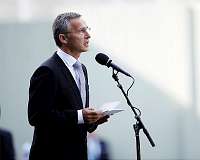
NATO Secretary General Jens Stoltenberg said Thursday that member state Turkey had a right to act in self-defence as Ankara presses a military operation against Kurdish-held positions in northern Syria.
"All nations have the right to defend themselves, but this has to be done in a proportionate and measured way," Stoltenberg said in a statement issued by his office.
Turkey launched an offensive against the Kurdish YPG militia on Saturday in their enclave of Afrin, supporting Syrian rebels with air strikes and ground troops.
Ankara views the YPG as a terror group linked to the outlawed Kurdistan Workers' Party (PKK) inside Turkey. The PKK is blacklisted by Ankara and its Western allies.
But the assault has raised fears among NATO member states that the fight against Islamic extremists in Syria might be impacted by Turkey's push.
"Turkey has also briefed Allies at NATO this week on their operation in northern Syria," Stoltenberg said.
"Turkey is one of the NATO nations that suffers the most from terrorism."
The NATO chief added that the alliance was providing air defence support for Turkey "against missiles fired from Syria" but stressed it had no forces on the ground in the war-torn nation.
US, Turkey discuss Syria safe zone: Pentagon
Washington (AFP) Jan 25, 2018 – US and Turkish military commanders have discussed the possibility of creating a "secure zone" along the border with Syria, a Pentagon spokesman said Thursday, amid rising tensions over Turkish intervention in the region.
"Clearly we continue to talk to the Turks about the possibility of a secure zone, whatever you want to call it," Lieutenant General Kenneth McKenzie told reporters.
"We've looked at that for a couple of years in various different iterations and no final decision on it yet. Our military commanders are still talking so I would say it's a concept that's out there … it's simply an idea that's floating around right now."
McKenzie did not go into details about what a safe zone might entail, but Turkish media have said Secretary of State Rex Tillerson told his Turkish counterpart Foreign Minister Mevlut Cavusoglu that he supports creating a secure area that reaches 30 kilometers (18.5 miles) into Syria.
The brutal Syrian war, which has claimed more than 340,000 lives since 2011, has grown even more complex over the past week with Turkey launching a ground operation against Kurdish fighters in northern Afrin, close to the Turkish border.
That has heightened tensions with NATO member Turkey's Western allies — particularly the United States, which has backed the Kurdish YPG in their fight against the Islamic State group.
"Particularly in Afrin, Turkish operations … that have the effect of inducing friction into the equation, of making it harder to focus on why we are in Syria … are a negative thing," McKenzie said, adding that he understood Turkey's "legitimate" security concerns.
The three-star general added that the Turkish operations in Afrin were "not helpful" in the fight against IS.
He would not comment on what the US military would do if the Turks move to the east and continue their push against the Kurds to the Kurdish-held city of Manbij.
If that happens, America would find itself at an extraordinary crossroads.
It would need to determine whether it would support its NATO ally Turkey, the Kurdish fighters it has backed to defeat IS, or somehow forge some sort of compromise between the two sides.
Dozens killed in attacks on Yemen rebel heartland
Clashes in the Yemeni rebel heartland of Saada province have killed 40 rebel fighters, Saudi media said Wednesday, while the rebels reported nine civilians among 22 dead in Saudi-led air strikes.
The rebels were killed in clashes over the past 24 hours with a pro-government alliance backed by Saudi Arabia, which controls several pockets of the province along the Saudi border, the kingdom's s … read more
