
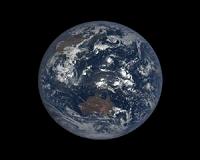
Over the week of May 15, extreme rainfall drenched northeastern Australia and NASA data provided a look at the record totals.
The rainfall was the heaviest rainfall in that area since tropical cyclone Debbie hit Queensland Australia in late March. Much of the recent extremely heavy rainfall was due to storms associated with a trough or elongated area of low pressure slowly moving over northeastern Queensland from the Coral Sea.
More than 100 millimeters or 3.9 inches of rain in 24 hours was reported near Townsville. A trough of low pressure that moved eastward from central Australia was also encroaching into western Queensland.
At NASA's Goddard Space Flight Center in Greenbelt, Maryland an analysis of rainfall over northeastern Australia was conducted using near real-time data from NASA's Integrated Multi-satellitE Retrievals for GPM (IMERG).
GPM is the Global Precipitation Measurement mission core satellite and there are a constellation of satellites that provide rainfall data with GPM that are fed into the IMERG calculations. GPM is a joint mission between NASA and the Japanese space agency JAXA.
The analysis showed an estimate of total precipitation accumulation over Queensland from May 17 to 19, 2017. IMERG total rainfall estimates indicated that up to 374 mm (14.5 inches) fell near the Queensland coast in this short period. IMERG rainfall totals in this analysis have been adjusted to reflect observed values in other similar extreme rainfall events.
Invention produces cleaner water with less energy and no filter
The same technology that adds fizz to soda can now be used to remove particles from dirty water. Researchers at Princeton University have found a technique for using carbon dioxide in a low-cost water treatment system that eliminates the need for costly and complex filters.
The system injects CO2 gas into a stream of water as a method of filtering out particles. The gas, which mixes with t … read more
