
America's powerful new deep space rocket, NASA's Space Launch System, will face harsh conditions and extreme temperatures in flight when launching NASA's Orion spacecraft and potential cargo to lunar orbit, and for that, it'll need strong protection.
Technicians and engineers have qualified 3D printing to aid in the application of the thermal protection system to the smaller, more intricate parts of the rocket. Spray-on foam or traditional insulation is applied to both large and small components of SLS; it protects the rocket from heat during launch and keeps the propellant within the large tanks cold.
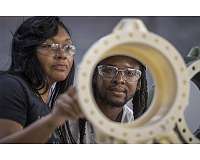
However, small hardware or cramped areas like the internal ducts of the engine section require technicians to either manually spray the foam on or apply a foam casting using, in some cases, a 3D printed mold.
During the process, the foam, which is mixed and poured into the mold, expands to perfectly fit the part. This decreases overall processing time by reducing the need for complex and tedious post-process trimming.
NASA and Boeing engineers performed extensive development and qualification pour foam testing early in the program. Using this data, the team developed a refined process that reduced the amount of time required to certify individual 3D printed molds and allowed the team to spend more time focusing on the critical requirements that must be met for each flight foam application. This streamlined the process, from 3D printing to pour application, and allowed for quicker processing times.
NASA is charged to get American astronauts to the Moon by 2024. Our backbone for deep space exploration is SLS and Orion, which will launch from NASA's Kennedy Space Center in Florida to the Gateway in lunar orbit. From there, astronauts will ultimately use a proposed human lunar landing system for missions to the surface of the Moon.
Space Launch System Ascent Testing Advances Understanding of Cargo Configuration
Hampton VA (SPX) Apr 15 – A Space Launch System (SLS) rocket model is prepped for wind tunnel testing by Courtney Winski, aerospace engineer, at the Unitary Plan Wind Tunnel at NASA's Langley Research Center in Hampton, Virginia.
The pink pressure-sensitive paint on the 0.8 percent scale model emits a bright crimson glow when reacting with oxygen in the presence of high-pressure airflows. This test allows engineers to understand changing pressures exerted on the rocket during a launch.
This round of ascent testing is latest in a series of wind tunnel tests for the rocket that will launch NASA's Orion spacecraft on missions to the Moon. Their first integrated test flight, known as Exploration Mission-1, is targeted for 2020, followed by a test flight with crew in 2022.
"Testing needs to happen in all potential rocket configurations and all stages of launch to know how the rocket will behave," said Jeremy Pinier, aerosciences team lead at Langley.
As they test different configurations of the rocket designed for crew and cargo, researchers are learning more about the structure and properties of the rocket NASA is developing for exploration of the Moon and Mars.
This particular test was one of the first in a series with the cargo configuration of SLS, which can send more than 26 metric tons (57,000) pounds to lunar orbit. The ability to carry large cargos to the Moon is necessary for human exploration missions.
