
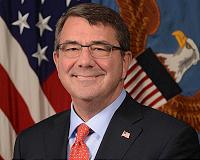
US Secretary of Defense Ash Carter said Sunday that operations to retake the Iraqi city of Mosul from the Islamic State group were key to defeating the jihadist group.
"This is a decisive moment in the campaign to deliver ISIL a lasting defeat," Carter said in a statement.
"We are confident our Iraqi partners will prevail against our common enemy and free Mosul and the rest of Iraq from ISIL's hatred and brutality."
Carter promised continued support for Iraq.
"The United States and the rest of the international coalition stand ready to support Iraqi Security Forces, Peshmerga fighters and the people of Iraq in the difficult fight ahead," he stressed.
The northern city was where IS supremo Abu Bakr al-Baghdadi publicly proclaimed a "caliphate" straddling Iraq and Syria in June 2014.
With the support of Iran and a US-led coalition, Iraqi forces have since regained much of the ground lost to IS and Mosul is the extremist group's last major stronghold in Iraq.
Prime Minister Haider al-Abadi has said only government forces will enter Mosul, a Sunni-majority city that IS seized with relative ease partly amid local resentment towards the Shiite-dominated security forces.
Shiite militia groups have been accused of serious abuses against Sunni civilians in the course of operations to reconquer territory from IS.
Mosul: Iraq's second city
Baghdad (AFP) Oct 17, 2016 –
Mosul was an Iraqi demographic mosaic of Arabs, Kurds, Turkmen and Christians that was gutted by years of violence culminating in the Islamic State group takeover in June 2014.
Prime Minister Haider al-Abadi announced on Monday that operations to retake it had begun.
Iraq's second-largest city, with a population now estimated at up to one million, mostly Sunni Arabs, Mosul is crucial to IS, which declared its Islamic "caliphate" there.
The United Nations has estimated that the battle for Mosul could displace a million people, and affect up to 1.5 million civilians in all.
The city controls strategic trade routes in northern Iraq, notably a key highway to the border with Syria and its second city of Aleppo, while other routes lead to Turkey and to Baghdad.
Food and fabrics have long been traded in Mosul, which is also known for producing the fine cotton called muslin.
The capital of Nineveh province, Mosul lies around 350 kilometres (220 miles) north of Baghdad, and 50 kilometres south of Iraq's biggest dam, now controlled by Kurdish peshmerga fighters.
The city's historic centre is dotted with church spires and it was home to an estimated 35,000 Christians when IS arrived and ordered them to convert, pay a special tax, or leave. Almost all fled.
Mosul was conquered by Arabs in 641 and reached its cultural peak in the 12th century before falling to Mongols in 1262, and then to Persians and Ottomans.
The city became part of Iraq when the country was created out of the ashes of the Ottoman Empire in the 1920s.
Nineveh has always been a border region, keenly contested by its rival communities and their more powerful supporters in neighbouring states.
Under the ousted Sunni-dominated regime of Saddam Hussein, Mosul saw a huge influx that boosted its population to around two million.
Disproportionate numbers were from Arab areas of the countryside, changing its demographic make-up. Arabs currently vastly outnumber Kurds.
The Tigris river runs down the middle of the city, with the eastern half more ethnically and religiously mixed while the western half is where IS found more support.
Mosul proved a bastion of Saddam's most dedicated supporters who became a foundation of IS, and extortion and protection rackets in the city were a major source of jihadist funding before it was overrun.
After chasing Iraqi troops out, IS set about destroying Mosul's cultural heritage, burning thousands of rare books and manuscripts in the city's vast library and smashing priceless statues.
In July 2014, IS fighters rigged the Nabi Yunus shrine — revered by both Muslims and Christians as the tomb of Prophet Jonah — with explosives and blew it up.
The population is now subject to a strict interpretation of Islamic law, and IS fighters have reportedly dug tunnel networks and planted munitions throughout the city in anticipation of the Iraqi counter offensive.
