
This could also lead to new applications such as switching between differing conductivities.
The HZB researchers studied crystalline semiconductor films made of a lead, tin, and selenium alloy (PbSnSe) that were doped additionally with tiny amounts of the element bismuth. These semiconductors belong to the new class of materials called topological insulators, materials that conduct very well at their surfaces while behaving as insulators internally.
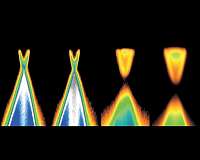
Doping with 1-2 per cent bismuth has enabled them to observe a new topological phase transition now. The sample changes to a particular topological phase that also possesses the property of ferroelectricity. This means that an external electric field distorts the crystal lattice, whereas conversely, mechanical forces on the lattice can create electric fields.
The effect can be used to develop new functionality, which is also of interest for potential applications. Ferroelectric phase-change materials are employed in DVDs and flash memories, for example. An electrical voltage displaces atoms in the crystal, transforming the insulating material into a metallic one.
The bismuth doping in the PbSnSe films investigated at HZB served as a perturbation. The number of electrons in bismuth does not fit well in the periodic arrangement of atoms within the PbSnSe crystal.
"Tiny changes in the atomic structure give rise to fascinating effects in this class of materials", explains HZB researcher Dr. Jaime Sanchez-Barriga, principal investigator coordinating the project.
Following detailed analyses of the measurements, only one conclusion remained: the bismuth doping causes a ferroelectric distortion in the lattice that also changes the allowable energy levels of the electrons.
"This problem kept us puzzled during several beamtimes until we reproduced the scientific results on a whole new set of samples", adds Sanchez-Barriga. "Potential applications could arise through ferroelectric phases – ones that have not been thought of before. Lossless conduction of electricity in topological materials can be switched on and off at will, by electrical pulses or by mechanical strain", explains Prof. Oliver Rader, head the department Materials for Green Spintronics at HZB.
Understanding rare earth emulsions
Despite their name, rare earth elements actually aren't that rare. Abundant in mines around the world, rare earths are used in many high-tech products, including visual displays, batteries, super conductors, and computer hard drives. But while they aren't necessarily tricky to find, the elements often occur together and are extremely difficult to separate and extract.
"Having the ability t … read more
