
The dwarf galaxy Gaia-Enceladus collided with the Milky Way probably approximately 11.5 billion years ago. A team of researchers including scientists from the Max Planck Institute for Solar System Research (MPS) in Germany for the first time used a single star affected by the collision as a clue for dating.
Using observational data from ground-based observatories and space telescopes, the scientists led by the University of Birmingham were able to determine the age of the star and the role it played in the collision. The research group describes its results in Nature Astronomy.
On cosmic time scales, the colliding and merging of galaxies is not uncommon. Even if both galaxies involved are of very different sizes, such a collision leaves clear traces in the larger one. For example, the smaller galaxy introduces stars with a different chemical composition, the motion of many stars is altered, and myriads of new stars are formed.
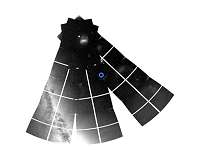
The Milky Way has encountered several other galaxies in its 13.5 billion-year history. One of them is the dwarf galaxy Gaia-Enceladus. To understand how this event affected our galaxy and changed it permanently, it is important to reliably date the collision. To this end, the researchers led by Prof. Dr. Bill Chaplin of the University of Birmingham turned their attention to a single star: nu Indi is found in the constellation Indus; with an apparent brightness comparable to that of Uranus, it is visible even to the naked eye and can be easily studied in detail.
"The space telescope TESS collected data from nu Indi already in its first month of scientific operation," says Dr. Saskia Hekker, head of the research group "Stellar Ages and Galactic Evolution (SAGE)" at MPS and co-author of the new study. The space telescope was launched in 2018 to perform a full-sky survey and characterize as many stars as possible. "The data from TESS allow us to determine the age of the star very accurately," Hekker adds.
Moreover, nu Indi provided clues on the history of the collision with the dwarf galaxy Gaia-Enceladus. To reconstruct its role in the collision, the research group evaluated numerous data sets on nu Indi obtained with the help of the spectrographs HARPS (High Accuracy Radial velocity Planet Searcher) and FEROS (Fiber-fed Extended Range Optical Spectrograph) of the European Southern Observatory, the Galaxy Evolution Experiment of the Apache Point Observatory in New Mexico, and ESA's Gaia Space Telescope. This allowed them to specify both the chemical composition of the star and its movement within the galaxy with great precision.
The cosmic detective work produced a clear picture: nu Indi has been part of the halo, the outer region of the Milky Way, and the collision changed its trajectory. "Since the motion of nu Indi was affected by the collision, it must have taken place when the star was already formed," Chaplin explains the line of argument. The age of the star therefore puts a constraint on the time of the collision.
To determine the age of a star, researchers use its natural oscillations, which can be observed as brightness fluctuations. "Similar to the way seismic waves on Earth allow conclusions about the interior of our planet, stellar oscillations help us to reveal the internal structure and composition of the star and thus its age," explains MPS scientist and co-author Dr. Nathalie Themessl.
The calculations carried out by MPS researchers and other research groups showed that with a probability of 95 percent the galaxy merger must have occurred 13.2 billion years ago. With a probability of 68 percent, the collision took place approximately 11.5 billion years ago.
"This chronological classification not only helps us to understand how the collision changed our galaxy," says Hekker. "It also gives us a sense, of how collisions and mergers impacted other galaxies and influenced their evolution."
additional report
TESS dates an ancient collision with our galaxy
Birmingham UK (SPX) Jan 14 – A single bright star in the constellation of Indus, visible from the southern hemisphere, has revealed new insights on an ancient collision that our galaxy the Milky Way underwent with another smaller galaxy called Gaia-Enceladus early in its history.
An international team of scientists led by the University of Birmingham adopted the novel approach of applying the forensic characterisation of a single ancient, bright star called ? Indi as a probe of the history of the Milky Way. Stars carry "fossilized records" of their histories and hence the environments in which they formed.
The team used data from satellites and ground-based telescopes to unlock this information from ? Indi. Their results are published in the journal Nature Astronomy.
The star was aged using its natural oscillations (asteroseismology), detected in data collected by NASA's recently launched Transiting Exoplanet Survey Satellite (TESS). Launched in 2018, TESS is surveying stars across most of the sky to search for planets orbiting the stars and to study the stars themselves.
When combined with data from the European Space Agency (ESA) Gaia Mission, the detective story revealed that this ancient star was born early in the life of the Milky Way, but the Gaia-Enceladus collision altered its motion through our Galaxy.
Bill Chaplin, Professor of Astrophysics at the University of Birmingham and lead author of the study said: "Since the motion of ? Indi was affected by the Gaia-Enceladus collision, the collision must have happened once the star had formed. That is how we have been able to use the asteroseismically-determined age to place new limits on when the Gaia-Enceladus event occurred."
Co-author Dr Ted Mackereth, also from Birmingham, said: "Because we see so many stars from Gaia-Enceladus, we think it must have had a large impact on the evolution of our Galaxy. Understanding that is now a very hot topic in astronomy, and this study is an important step in understanding when this collision occurred."
Bill Chaplin added: "This study demonstrates the potential of asteroseismology with TESS, and what is possible when one has a variety of cutting-edge data available on a single, bright star"
The research clearly shows the strong potential of the TESS programme to draw together rich new insights about the stars that are our closest neighbours in the Milky Way. The research was funded by the Science and Technology Facilities Council and the European Research Council through the Asterochronometry project.
