
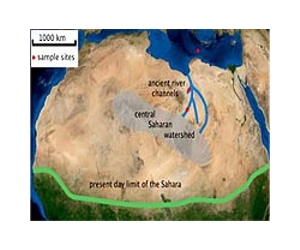
Three ancient river systems, now long buried, may have supported ancient human migration routes out of Africa to the Mediterranean, British researchers say.
Tom Coulthard from the University of Hull, along with colleagues from other institutions, simulated paleoclimates in the region that suggested three major river systems likely existed in North Africa 130,000 to 100,000 years ago, although they are now largely buried under desert dunes.
When flowing they would have created fertile habitats for animals and vegetation and served as "green corridors," providing likely routes of human migrations across the region, the researchers said.
While previous studies have shown people traveled across the Saharan mountains toward more fertile Mediterranean regions, when, where and how they did so has long been a subject of debate.
"It's exciting to think that 100,000 years ago there were three huge rivers forcing their way across 1,000 kilometers (620 miles) of the Sahara desert to the Mediterranean — and that our ancestors could have walked alongside them," Coulthard said.
In addition to rivers, the researchers said, their simulations predicted massive lagoons and wetlands in northeast Libya, some of which may have been as large as 27,000 square miles.
The study has been published in the journal PLoS ONE.
New technology can identify source of ancient stone tools quickly
Sheffield, England (UPI) Sep 11, 2013 –
Stone tools made of obsidian found at archaeological digs can be traced to their geological source in seconds with a new instrument, British researchers say.
Obsidian, naturally occurring volcanic glass, is hard and sharp when fractured, making it a highly desirable raw material for crafting stone tools for almost all of human history, they said.
Some obsidian tools found in East Africa are nearly 2 million years old, they said.
The chemistry of obsidian varies from volcano to volcano and represents a "fingerprint" allowing researchers to match an obsidian artifact to the volcanic origin of its raw material, but such tests previously required sophisticated equipment in laboratories and often had to wait for months or even years after an archaeological site had been excavated.
Researchers at the University of Sheffield report they've created a hand-held instrument using an analytical technique called portable X-ray fluorescence that enables archaeologists to identify the origins of stone tools in the field rather than having to send them off to a distant lab.
"Obsidian sourcing has, for the last 50 years, involved chemical analysis in a distant laboratory, often taking 5 minutes per artifact, completely separate from the process of archaeological excavation," Sheffield archaeologist Ellery Frahm said.
"We can now analyze an obsidian artifact in the field, and just 10 seconds later, we have an answer for its origin," he said.
